ICICI Prudential Life Cycle Funds: 2031, 2036 or 2041?

ICICI Prudential has launched three Life Cycle Fund NFOs targeting 2031, 2036 and 2041. With the NFO window closing on September 9, 2026, this guide breaks down the product structure, SEBI-mandated glide path, investment strategy, costs, risks, taxation and suitability to help MFDs evaluate which fund makes sense for their clients.
Here is a comprehensive snapshot of the features of the NFOs:
Product detail | 2031 | 2036 | 2041 |
|---|---|---|---|
Product name | |||
Target year | 2031 | 2036 | 2041 |
Investment horizon | 5 years | 10 years | 15 years |
NFO open date | 26-Aug-26 | 26-Aug-26 | 26-Aug-26 |
NFO close date | 09-Sep-26 | 09-Sep-26 | 09-Sep-26 |
NFO NAV | 10 | 10 | 10 |
Minimum investment | 100 | 100 | 100 |
Investment objective | Open-ended life cycle fund with maturity of 5 years following glide path approach for goal-based investing | Open-ended life cycle fund with maturity of 10 years following glide path approach for goal-based investing | Open-ended life cycle fund with maturity of 15 years following glide path approach for goal-based investing |
Primary goal alignment | Short-to-medium term goals (e.g., home upgrade) | Medium-to-long term goals (e.g., child's education) | Long-term goals (e.g., retirement) |
Initial equity allocation | 35–50% | 50–65% | 65–80% |
Benchmark | Nifty 200 TRI (50%) + Nifty Composite Debt Index (45%) + Gold (3%) + Silver (2%) | Nifty 200 TRI (65%) + Nifty Composite Debt Index (30%) + Gold (3%) + Silver (2%) | Nifty 200 TRI (65%) + Nifty Composite Debt Index (30%) + Gold (3%) + Silver (2%) |
Fund managers | Aatur Shah, Manish Banthia, Rohit Lakhotia, Gaurav Chikane | Manasvi Shah, Manish Banthia, Rohit Lakhotia, Gaurav Chikane | Divya Jain, Manish Banthia, Rohit Lakhotia, Gaurav Chikane |
Plans / options | Growth | Growth | Growth |
Exit load | If redeemed before 1 year - 3% | If redeemed before 1 year - 3% | If redeemed before 1 year - 3% |
What Is a Life Cycle Fund and How Does It Work?
A life cycle fund is a mutual fund built around a fixed target year, where the portfolio automatically shifts from equity to debt as that year approaches, following a glide path SEBI standardised on February 26, 2026. ICICI Prudential's Life Cycle Funds 2031, 2036 and 2041 are among the first NFOs in this new category based on active investing, each following the same regulatory glide path with different starting points.
This category attempts to replace the old "solution-oriented schemes" bucket, which used to cover retirement and children's funds under a looser structure. Here's the part most MFDs haven't seen laid out: SEBI didn't just define the concept; it prescribed the actual allocation bands. Every AMC's life cycle fund, not just ICICI Prudential's, has to sit within this table.
Years to Maturity | Equity Allocation | Debt Allocation | Gold/Silver ETFs, ETCDs, InvITs |
|---|---|---|---|
15-30 years | 65%-95% | 5%-25% | 0%-10% |
10-15 years | 65%-80% | 5%-25% | 0%-10% |
5-10 years | 50%-65% | 5%-25% | 0%-10% |
3-5 years | 35%-50% | 25%-50% | 0%-10% |
1-3 years | 20%-35% | 25%-65% | 0%-10% |
Less than 1 year | 5%-20% | 25%-65% | 0%-10% |
Source: SEBI Circular on Categorization and Rationalization of Mutual Fund Schemes, dated February 26, 2026
Two more rules sit inside that table and rarely make it into sales pitches. Debt holdings in the final 1-3 years must be AA-rated or higher, with residual maturity shorter than the scheme's own target maturity. That's a real constraint on how conservative the fund can get near the end, and it's worth knowing before you tell a client the fund "goes fully safe" near maturity. It doesn't; it goes investment-grade-safe, which isn't the same thing as a fixed deposit.
How Does the ICICI Prudential Life Cycle Fund Glide Path Work?
In general, the equity allocation forms a major portion of the fund’s portfolio and this keep on reducing as the fund approaches maturity. Here are the glide paths for the three NFOs.
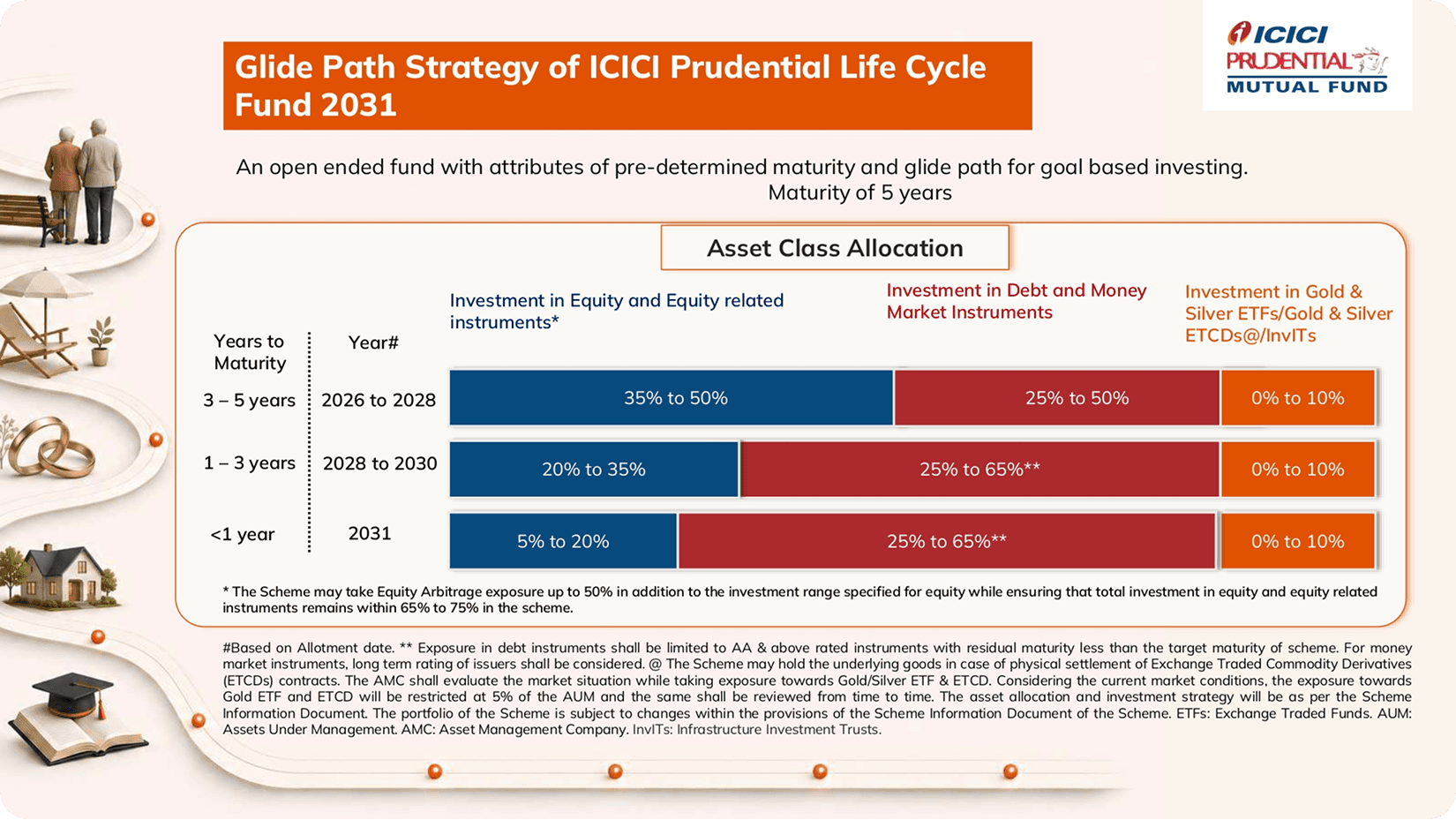
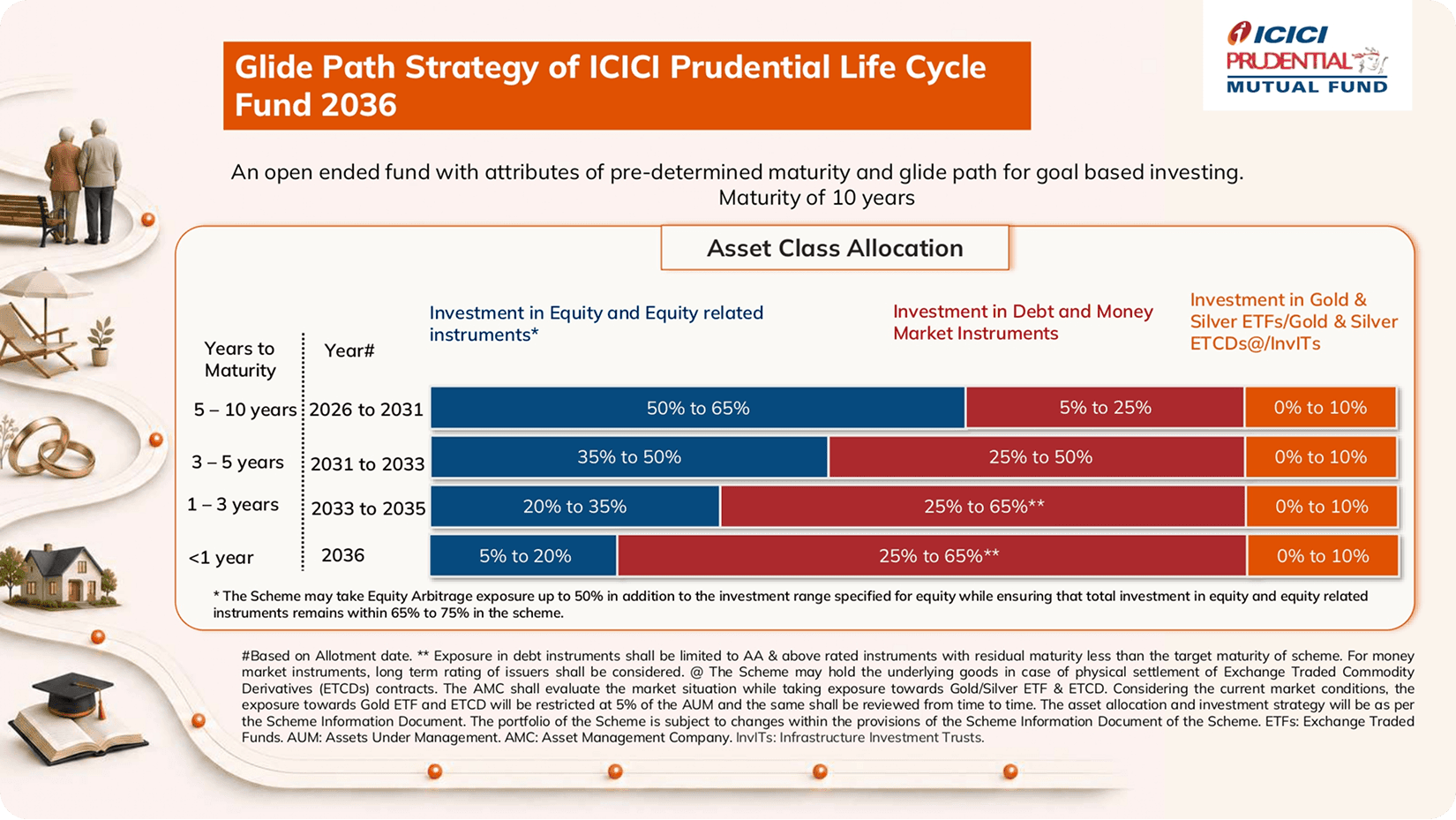
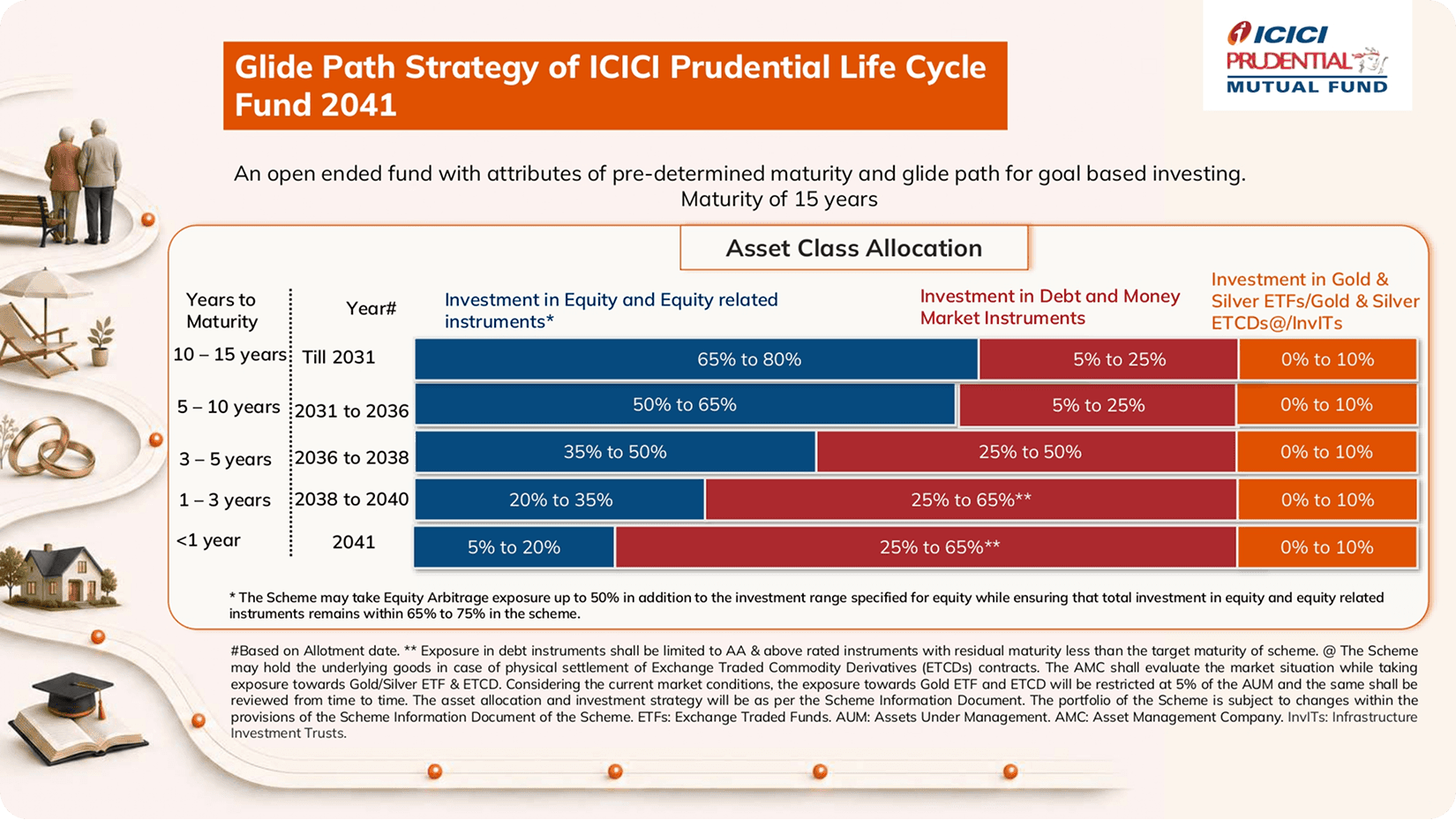
The glide paths are aligned with SEBI’s prescribed bands. ICICI’s fund management team will have the discretion to manoeuvre within these bands based on their market outlook. They have the option to allocate upto 10% in gold & silver ETFs / ETCDs and InvITs however they intend to restrict it to 5% based on current market conditions and the same will be reviewed from time to time.
ICICI Prudential Life Cycle Fund 2031 vs 2036 vs 2041: What Is the Difference?
The underlying difference between the 3 funds is the target maturity year, which is resulting in differing equity allocations at the beginning of the fund. The 3 funds have common fund managers comprising of Manish Banthia, Rohit Lakhotia and Gaurav Chikane; while Aatur Shah is in 2031 fund, Manasvi Shah in the 2036 fund and Divya Jain in the 2041 fund.
The 2036 and 2041 funds share an identical benchmark. The only structural difference between them is where each starts on the same glide path, since a 15-year investor begins further from maturity than a 10-year investor. If a client asks "what's actually different between the 2036 and 2041 fund," the honest answer is: almost nothing except how many years of runway they get before the fund starts de-risking.
What Is the Investment Strategy of ICICI Prudential Life Cycle Funds?
The funds will invest in equity, debt, gold & silver ETFs / ETCD based on the glide path strategy. The investment decision in terms of equities will be based on active investing and flexibility to invest across market capitalisation as well as industries.
Which ICICI Prudential Life Cycle Fund Could Suit Your Client?
MFDs can match the 2031/2036/2041 funds to the investment horizon of the client or to the client’s specific goal timeline. Besides this, risk capacity as well as goal flexibility should be client goal horizon, risk capacity, goal flexibility and investment horizon.
What Are the Benefits of ICICI Prudential Life Cycle Funds?
Goal alignment, predefined glide path, automatic rebalancing/de-risking, diversification and reduced need for manual asset allocation. MFDs need not track and manually change the asset allocation as they approach the client’s goal.
What Are the Risks and Limitations of ICICI Prudential Life Cycle Funds?
Market Risk: During high equity phases, the fund remains exposed to broader stock market volatility.
Credit & Interest Rate Risk: These risks will remain for the debt allocation, making it different to pure fixed income instruments like Fixed Deposits.
Fixed Glide Path Rigidity: The glide path follows a pre-set timeline. The fund manager de-risks based on the target year, regardless of whether equity markets are currently undervalued or overvalued.
Timeline Mismatch: If your personal goal timeline shifts unexpectedly (e.g., needing funds earlier than the target maturity year), early redemptions within 3 years may incur heavy exit loads of upto 3%.
Lack of historical track record: Lifecycle funds are new offerings in the market with no track record. There is no guarantee of getting your entire capital back at maturity.
What Are the Exit Load, Taxation and Other Costs?
SEBI's framework applies the same exit load structure across every life cycle fund, regardless of AMC: 3% if you redeem within 1 year, 2% within 2 years, 1% within 3 years, and nil after that. This isn't ICICI Prudential's own policy. It's the category-wide rule, which means a client can't dodge it by picking a different AMC's life cycle fund instead.
Lifecycle funds offer significant tax advantages:
No Capital Gains Trigger on Rebalancing: If an investor manually sells equity fund units to buy debt funds during portfolio de-risking, each transaction triggers capital gains tax. In contrast, when a lifecycle fund shifts its internal asset allocation along its glide path, no tax liability is passed on to the investor.
Equity Taxation Preservation via Arbitrage: To retain tax treatment as an equity-oriented fund even as directional stock exposure drops, the scheme utilizes equity arbitrage (up to 50%). This maintains total equity and derivative exposure within the 65%–75% band required for equity tax status while effectively neutralizing market directional risk in the fund's final years.
Taxation on Redemption: Normal equity mutual fund taxation will be applicable to lifecycle funds. Short term capital gains tax at 20% for investment held for up to 12 months and 12.5% long term capital tax for investment held for more than 12 months.
The base TER of Lifecycle Fund 2031 is upto 2.1% for the first 500cr of AUM and will gradually reduce as AUM increases.
What Happens When an ICICI Prudential Life Cycle Fund Reaches Its Target Year?
These are open-ended schemes. Clients aren't forced to redeem at maturity, and SEBI's framework allows near-maturity funds to be merged into the closest-dated option if a client stays invested.
What Happens to Existing Retirement and Children's Fund Investors?
If any of your clients are sitting in ICICI Prudential's Retirement Fund or the erstwhile Child Care (Gift Plan), now called Children's Fund, this is worth a proactive call. SEBI's February circular discontinued the "solution-oriented schemes" category that these funds used to sit under. Existing schemes in that bucket are expected to stop accepting fresh subscriptions and get merged into schemes with a similar asset allocation and risk profile, subject to SEBI's approval process.
In its March 2026 master circular, SEBI partially reversed course by permitting fund houses to continue offering children's and retirement funds after all, but with one specific condition attached. A fund house that chooses to keep offering a children's / retirement fund cannot simultaneously launch a 20-year / 30-year Life Cycle Fund; it may still offer the other five tenures (5, 10, 15, and 25 years), just not the 20-year / 30-year options.
That doesn't mean existing investors lose money or get forced out overnight. It does mean the fund your client bought three years ago under a "retirement" label may look structurally different, or carry a different name, within the next few quarters.
Platforms like Creso surface these scheme-merger notices against your existing book automatically, so you're not relying on catching an AMC circular in your inbox to have this conversation before your client does.
How Do ICICI Prudential Life Cycle Funds Compare With Other Life Cycle Funds?
Here's a detail that changes how you can position this NFO to a client: ICICI Prudential isn't the first mover here. Zerodha Fund House launched India's first life cycle funds back in June-July 2026, about two months before ICICI Prudential's NFOs opened, with its own 2031, 2036 and 2041 variants. Because both AMCs are bound by the same SEBI allocation grid, the two houses' funds will carry near-identical equity and debt bands at any given point on the glide path. The real difference between them comes down to stock selection within equity, credit selection within debt, and cost, not the allocation framework itself. The key difference also lies in equity selection wherein Zerodha Fund House will follow a passive investing style, while ICICI Prudential’s equity investing is active in nature.
What Should You Evaluate Before Recommending an ICICI Prudential Life Cycle Fund?
Before recommending to clients, consider the following parameters:
Horizon Alignment: Ensure client’s target goal year closely matches the fund’s maturity year (2031, 2036, or 2041).
Liquidity Needs: Factor in the 3-year exit load tier if you think client might need the capital early.
Rigidity of the Glide Path: Understand that the fund automatically de-risks based on time remaining, regardless of whether equity markets are currently cheap or expensive.
Risk Profile: While equity risk drops significantly in the final years, early-stage allocations still carry high market volatility.
ICICI Prudential Life Cycle Fund 2031, 2036 & 2041: Key Takeaways
Lifecycle funds is a new category of mutual funds – ideal for tenure-linked goals of clients. It also saves MFDs the hassle of manually tracking and re-balancing the portfolio over the cycle of client’s goals. However, it could also be perceived as competition to an MFD – what MFD would do for an investor (over the tenure of their goals) will now happen automatically. So investors may be tempted to go with direct route of mutual funds instead of MFD-advices regular funds.
The re-balancing done by a lifecycle fund (along the glide path) is tax-free. Before lifecycle funds, the investor would have to pay taxes on redemption when re-balancing. Further, ICICI’s lifecycle funds would enjoy the benefit of equity taxation.
Glide path is constant across all fund offerings of the same tenure, AMCs create differentiation in selection within asset class. For example, ICICI Prudential’s offering is active, while Zerodha AMC’s is passive.
While the tenure of the funds is fixed, there is enough flexibility in the system – you can redeem early if you want (subject to applicable exit loads) or merge with other funds if you want to stay invested.
FAQs About ICICI Prudential Life Cycle Fund 2031, 2036 & 2041
Q: What is a life cycle fund in mutual funds?
A: A life cycle fund is an open-ended mutual fund category, introduced by SEBI on February 26, 2026, with a predetermined maturity year built into the scheme's name and a fixed glide path that reduces equity exposure and increases debt exposure as that year approaches.
Q: What are the New Fund Offer (NFO) dates for the ICICI Prudential Life Cycle Funds?
A: The New Fund Offer (NFO) for the ICICI Prudential Life Cycle Funds opens on August 26, 2026 and closes on September 09, 2026.
Q: How do the 2031, 2036, and 2041 variants differ from each other?
A: The main differences lie in their time horizons, maturity years, and initial asset allocations:
ICICI Prudential Life Cycle Fund 2031: Designed for a 5-year goal horizon (maturing in 2031) with an initial equity allocation of 35% to 50%.
ICICI Prudential Life Cycle Fund 2036: Designed for a 10-year goal horizon (maturing in 2036) with an initial equity allocation of 50% to 65%.
ICICI Prudential Life Cycle Fund 2041: Designed for a 15-year goal horizon (maturing in 2041) with an initial equity allocation of 65% to 80%.
Q: Who should consider investing in lifecycle funds?
A: These funds are suitable for investors who:
Have a specific financial milestone in mind with a known timeline.
Want a hands-off, hassle-free investment where asset allocation and rebalancing are handled professionally.
Seek multi-asset diversification (equity, debt, gold, silver, InvITs) under a single structure.
Want to avoid emotional decision-making or behavioural biases during market ups and downs.
Q: Is ICICI Prudential Life Cycle Fund 2031, 2036 or 2041 the same as a retirement or children's fund?
A: No. Life Cycle Funds are a distinct SEBI category built around a target maturity year and a standardised glide path. Retirement and children's schemes previously sat under the "solution-oriented schemes" category, which SEBI discontinued in the same February 2026 circular.
Q: What is the exit load on these funds?
A: The exit load structure is set by SEBI for the entire life cycle fund category, not by individual AMCs: 3% if redeemed within 1 year, 2% within 2 years, 1% within 3 years, and nil after 3 years.
Q: Can I invest through a SIP in a life cycle fund?
A: These are open-ended schemes, so SIP availability depends on the specific AMC's platform and scheme features once the NFO closes and the fund reopens for ongoing subscriptions.
Q: How is a life cycle fund taxed?
A: Life cycle funds aim to retain equity-fund taxation throughout their life, including in the final years when directional equity exposure is low, by using equity arbitrage positions (up to 50%) to keep total equity-plus-arbitrage exposure within the 65%-75% band SEBI requires for equity tax treatment. Actual tax outcomes still depend on when and how an investor redeems, and on prevailing tax rules at that time.
Q: What happens to my investment after the fund reaches its target maturity year?
A: The scheme remains open-ended, so investors aren't forced to redeem at maturity. Regulatory reporting on the category indicates near-maturity schemes may be merged into the nearest-maturity life cycle fund, subject to SEBI's approval process, if an investor chooses to stay invested.
If you're trying to keep track of which of your clients' existing scheme holdings are affected by SEBI's solution-oriented category phase-out, or want scheme-change alerts flowing into your practice automatically instead of manually scanning AMC circulars, see how Creso handles regulatory and scheme-change tracking for MFDs.