IT Sectoral Funds in India: Performance, Risks and Which Funds Stand Out (2026)

A sudden jump in the NAV of Motilal Oswal’s Digital India fund caught everyone’s attention. While that was driven by a one-off, we take this opportunity to dig deeper into sectoral funds in the IT/Technology. IT sectoral funds in India have had a rough 18 months. The five largest funds are down up to 15% over the past year, with 5-year CAGRs stuck below 7%. But a handful of newer, smaller funds have bucked that trend - and the reasons why tell you a lot about how to think about this category.
How have IT Sectoral Funds in India Performed?
Sectoral technology MFs have fallen by up to 15% over the last 1 year, while the 5-yr performance CAGR has been weak at sub-7%. This can be attributed to earnings downgrades on the back of slower than expected revenue growth and margin pressures, besides concerns about the impact of AI on traditional outsourcing business models of Indian IT companies.
Performance of the 5 Largest Sector Funds
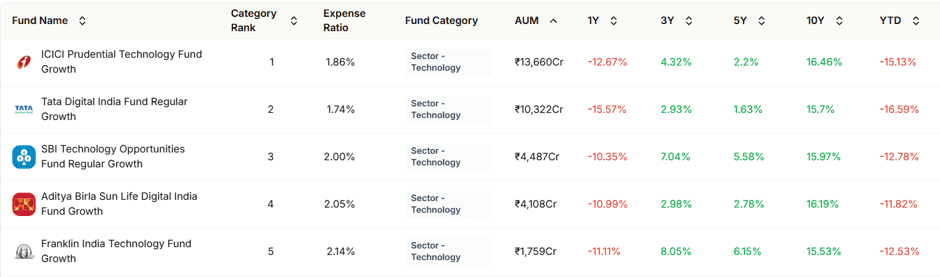
Source: Morningstar, Creso; updated on closing NAVs as 18 Sept 2026
Newer Funds have Performed Better
The relatively newer funds, with lower AUMs and limited operating history have performed better than the largest 5 in the near term.
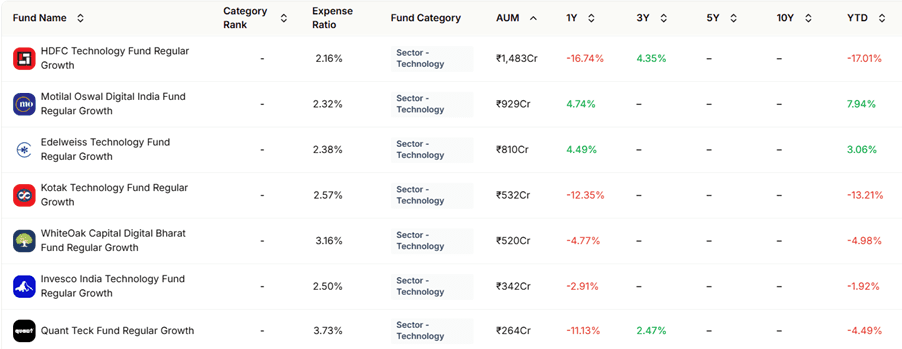
Source: Morningstar, Creso; updated on closing NAVs as 18 Sept 2026
What Causes the Performance Gap Between IT Funds?
We believe the newer funds have been able to perform better due to:
Differentiated Portfolio Construction
A portfolio overlap analysis among the 12 active technology funds indicates that newer funds like Motilal Oswal Digital India Fund, WhiteOak Capital Digital Bharat Fund and Edelweiss Technology Fund have created a differentiated portfolio structure within the category.
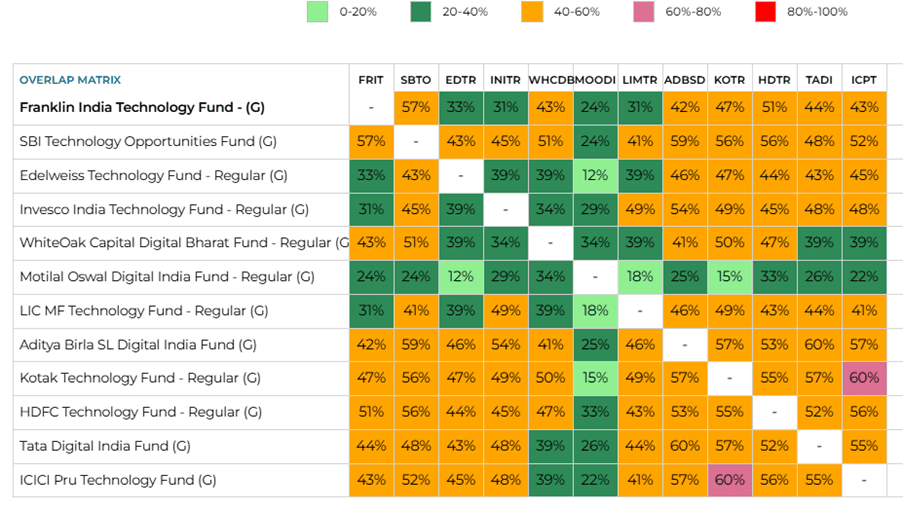
Source: Ngen Markets
Greater Manoeuvrability
Smaller AUMs allow these funds to invest in emerging IT companies or companies with smaller market caps, which are usually unavailable to the larger funds due to high impact costs. This is clearly visible when you look at the holdings of these funds – larger funds have a higher Large Cap inclination in their portfolio.
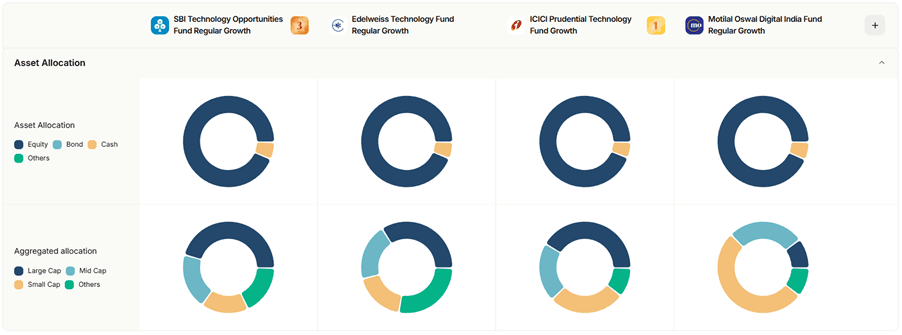
Source: Morningstar, Creso
In general, most larger technology funds have low exposure (15-25%) to smallcap IT stocks, while Motilal Oswal Digital India Fund stands out at the other extreme with ~60% exposure to smallcap IT. This means it can have a meaningful exposure to new age IT companies in India – high risk, high return bets.
One-off Bumper Gains
Motilal Oswal Digital India Fund got an anchor allocation of ~Rs. 44 crores (which is ~5% of their entire AUM) in the IPO of a company called ESDS Software Solutions Limited. The anchor allocation was at a price of Rs. 429/share. As of 18 September 2026 (less than 15 days after listing), the price was Rs. 1,560/share. This one stock itself lifted the NAV of the fund by ~13% in less than 15 days.
Global Allocation
Some funds also dynamically allocate a portion of their assets to global technology giants, providing valuable geographical diversification. SBI Technology Opportunities Fund has invested ~17% of its portfolio in global tech stocks, while ICICI Prudential Technology Fund has a lower allocation at ~9%. Edelweiss Technology Fund stands out with ~28% portfolio exposure to global tech stocks.
Why Consider IT Sectoral Funds Now? The Bull Case
Adding an IT sectoral fund to your portfolio comes with several distinct structural advantages:
High Growth Potential: The tech sector is synonymous with rapid innovation and Indian IT companies are expected to pivot from their existing business models towards AI related services.
The Currency Hedge Advantage: The domestic IT sector is heavily export-oriented (majority revenue from US and European markets) and benefits from rupee depreciation. This inherent currency hedge adds a layer of stability to IT funds during times of domestic economic stress.
Omnipresence Across Industries: Unlike cyclical sectors such as metals or infrastructure, technology is an indispensable utility. Banks, hospitals, automobile manufacturers, and retail chains all rely heavily on complex IT infrastructure to survive. This ubiquitous, cross-sector demand ensures a steady pipeline of contracts and revenues for top IT firms, offering a structural growth story that spans decades.
Execution Track Record: Indian IT companies have an established track record of executing large-scale projects. This coupled with long-standing client relationships and understanding of regulatory and industry-specific requirements, places them well in the evolving eco-system.
Potentially Reasonable Valuations: Various market experts and fund managers have pointed out that many IT stocks are available at historically low valuations and attractive dividend yields – due to the sharp decline prices of these stocks in the recent past.
The Risks of IT Sectoral Funds MFDs Should Flag to Clients
While the long-term rewards can be promising, IT sectoral funds are not without their pitfalls. Investors must tread carefully and understand the specific vulnerabilities of the sector.
Valuations & AI Disruption: Tech stocks frequently trade at premium valuations due to their high growth prospects. However, given the current headwinds in the earnings growth of Indian IT stocks, valuations have seen a painful drawdown and it may become prolonged in nature. While these stocks are available at lower valuations relative to history, they could also be a ‘valuation trap’. The near-term revenue growth guidance is weak as traditional outsourcing model is getting disrupted, besides accentuated margin pressures on account of employee upskilling, AI partnerships, new service models, etc.
Concentration Risk: The fundamental flaw of any sectoral fund is its deliberate lack of diversification. If the IT sector faces headwinds such as intense regulatory crackdowns, changing visa policies in the US, or a broad slowdown in global tech spending; the entire mutual fund will suffer, with no other sectors (like FMCG or Pharma) in the portfolio to cushion the fall.
Economic Sensitivity: The fortunes of Indian IT companies are closely tethered to the economic health of the Western nations. A recession, or inflation-induced monetary tightening in the US or Europe, often leads to reduced corporate IT budgets. This directly impacts the order books and revenues of IT service providers held in the fund’s portfolio.
Who Should Invest in IT Sectoral Funds? A Framework for MFDs
We recommend MFD partners to use sectoral funds as a "satellite" allocation; meaning they should make up no more than 10–15% of your client’s overall equity portfolio. However, recommending thematic / sectoral funds means consistently tracking the sector and exiting the investments if your thesis does not play out – only those who are able to track a particular sector should refer thematic / sectoral funds
Further, given their highly concentrated nature, IT sectoral mutual funds are strictly suited for aggressive investors with a high-risk appetite and a genuinely long-term investment horizon of at least 5 to 7 years.
The negative buzz surrounding Indian IT stocks, cautious management outlook and business models undergoing disruption presents a unique opportunity to evaluate sectoral IT funds from a 5 – 7 year investing horizon to generate that extra alpha.
FAQs
Q: What are IT sectoral funds in India?
A: IT sectoral funds are mutual funds that invest exclusively in companies from the information technology sector - primarily Indian IT services companies, software firms, and technology-enabled businesses. Unlike diversified equity funds, they make limited allocation to other sectors. This concentration means returns are entirely dependent on how the IT sector performs, which makes them higher-risk than a typical equity fund.
Q: What caused the sudden jump in Motilal Oswal Digital India Fund's NAV?
A: The spike was driven by a single IPO allocation. The fund received an anchor allotment of approximately ₹44 crores in ESDS Software Solutions Limited at ₹429 per share. Within 15 days of listing, the stock was trading at ₹1,560 per share. That one position lifted the fund's NAV by roughly 13%. It was a one-off event, not a signal of broader sector recovery, and MFDs should be careful not to present it to clients as such.
Q: How much of a client's portfolio should be in IT sectoral funds?
A: No more than 10–15% of the overall equity allocation, and only as a satellite position. The core of a client's portfolio should remain in diversified equity funds. Sectoral funds require active monitoring - if the original investment thesis stops playing out, the position should be exited. MFDs who recommend sectoral funds should have a clear view on when they would advise a client to get out, not just when to get in.
Tracking a client's sectoral exposure across a multi-fund portfolio isn't easy to do manually. If you want visibility across your entire book — including which clients are overweight IT – Visit Creso | Everything MF Distributors Need in One Platform.
Disclaimer: Investment in mutual funds is subject to market risks. Please read all scheme-related documents carefully before investing.