Investing in REITs Through Mutual Funds: How the New REIT Index Funds Work?

REIT mutual funds in India let investors access commercial real estate returns through a regular mutual fund account. Four new funds launched in 2026 - from Navi, Edelweiss, WhiteOak Capital, and HDFC - each taking a different approach: some passive index trackers, one active dividend-yield strategy.
For years, investing in real estate in India largely meant buying a house, an office, a shop or a plot.
That is changing. Real Estate Investment Trusts (REITs) have already given investors a way to participate in income-generating commercial real estate without buying property themselves. Now, mutual funds are beginning to package this opportunity in different ways.
The Edelweiss Nifty REITs & Realty Index fund went live recently. WhiteOak Capital Dividend Yield fund’s NFO is closing today and intends to provide a REIT focused dividend investing portfolio. Navi MF and HDFC MF are also coming up with their own REITs & Realty Index.
Before we jump in to the specifics of each issue, let us understand what REITs are:
What is a REIT?
A Real Estate Investment Trust is a vehicle that owns or has interests in income-generating real estate assets. Instead of an investor buying an entire commercial building, a REIT allows them to own units of a professionally managed portfolio of properties.
REITs can own assets such as office buildings, shopping centres and other commercial properties.
One of their important characteristics is the requirement to distribute a substantial portion of their distributable cash flows to unitholders. This is why REITs are often associated with income generation.
REIT ≠ Realty company. A REIT generally owns income-generating property. A realty company may develop, construct and sell property.
The sources of return can therefore be quite different.
Why are REIT Mutual Funds becoming popular in India?
There are a few developments coming together.
1. India's listed REIT universe is expanding
India's REIT market has moved beyond being a niche institutional product. More listed trusts are providing investors access to commercial real estate through the stock exchanges.
However, the universe is still relatively small.
That limited number of listed REITs is one reason the new REIT-oriented indices do not necessarily consist entirely of REITs.
2. REITs have received an equity classification
A significant regulatory development was SEBI's decision to classify REITs as equity instruments for mutual-fund purposes.
This makes it easier for fund houses to build equity-oriented products around REITs and include them within equity indices. The change has been an important catalyst for the emergence of REIT-focused passive products.
3. Dedicated indices have emerged
Two different approaches are now visible.
The Nifty REITs & Realty Index combines REITs with listed realty companies.
The newer BSE REITs and Commercial Real Estate Index takes a somewhat different route, combining listed REITs with companies having significant exposure to commercial real estate. BSE describes the index as a benchmark for the commercial real-estate ecosystem and has designed it to support passive products such as ETFs and index funds.
This distinction is important.
The mutual-fund industry is not simply creating "REIT funds".
It is creating different ways of accessing the economics of real estate.
Comparing REIT Mutual Funds in India: Navi v/s Edelweiss v/s Whiteoak v/s HDFC
We have attempted to decode the differences between them as under:
Feature / Metric | Navi Nifty REITs & Realty Index Fund | Edelweiss Nifty REITs & Realty Index Fund | WhiteOak Capital Dividend Yield Fund | HDFC BSE REITs & Commercial Real Estate Index Fund |
|---|---|---|---|---|
NFO / Launch Dates | Aug-26 | 05 August 2026 – 19 August 2026 | 10 August 2026 – 24 August 2026 | To be announced |
Active vs. Passive | Passive (Index Fund) | Passive (Index Fund) | Active (Equity Scheme) | Passive (Index Fund) |
Benchmark Index | Nifty REITs & Realty TRI | Nifty REITs & Realty TRI | BSE 500 TRI | BSE REITs & Commercial Real Estate TRI |
Investment Philosophy | Tracking Nifty REITs & Realty Index, subject to tracking errors (TRI) | Tracking the Nifty REITs & Realty Index (TRI), subject to tracking errors | Active stock selection targeting dividend-yielding companies, with flexibility to allocate up to 60% in REITs and 10% in InvITs. | Tracking BSE REITs & Commercial Real Estate Index (TRI), subject to tracking errors |
Target Asset Split | ~60% REITs / ~40% Realty Stocks | ~60% REITs / ~40% Realty Stocks | Broad equity portfolio + up to 60% REITs & 10% InvITs | REITs (minimum 65%) + Real Estate companies that have >10% rental income |
Fund Manager(s) | Ashutosh Shirwaikar | Bharat Lahoti & Manasi Jalgaonkar | Ramesh Mantri, Ashish Agrawal, Dheeresh Pathak, Piyush Baranwal, Trupti Agrawal | Nandita Menezes, Arun Agarwal |
Riskometer Level | Very High | Very High | Very High | Very High |
Tax Efficiency | Growth option: Gains deferred until redemption; distributions reinvested into NAV. LTCG: 12.5% (holding period of > 24 months) STCG: Applicable slab rates | |||
WhiteOak Capital Dividend Yield Fund: What Makes It Different?
The WhiteOak Capital Dividend Yield Fund presents a different proposition by modernizing dividend focused investing. Traditional dividend yield schemes predominantly invest in mature equity stocks whose payouts depend strictly on corporate profit cycles.
Here’s a peek into the top 10 holdings of four traditional dividend yield schemes:
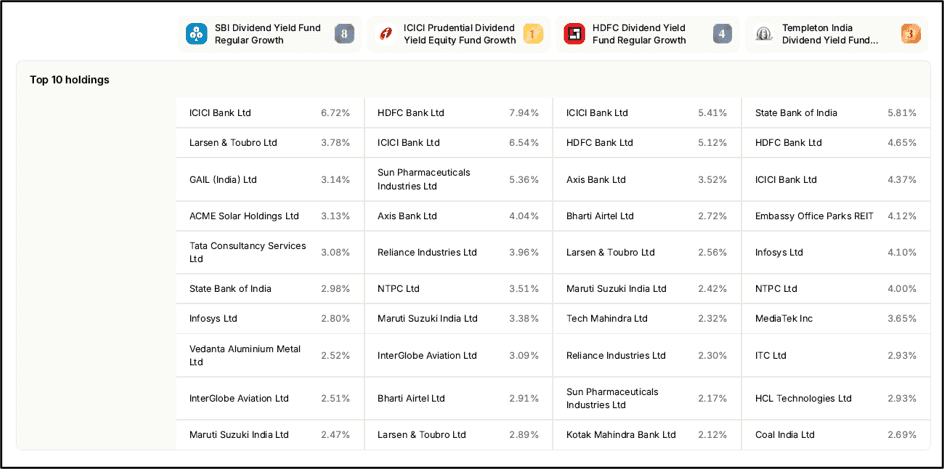
Source: Creso.in, Morningstar
In contrast, WhiteOak expands its investment horizon into institutional-grade real assets, allocating up to 60% to REITs and up to 10% to InvITs.
This structural shift anchors cash-flow generation to signed, contractual lease agreements and tariff-linked revenues rather than fluctuating corporate dividend declarations. By combining commercial real estate, infrastructure assets, dividend-yielding equities, and arbitrage (up to 25%), the fund delivers multi-asset diversification.
With an active management framework evaluating tenant quality, occupancy risks, and lease escalations, WhiteOak offers investors a unique hybrid strategy designed to provide inflation-hedged cash flows, lower portfolio volatility, and steady long-term capital appreciation.
Here is the WhiteOak’s way of dividend investing:
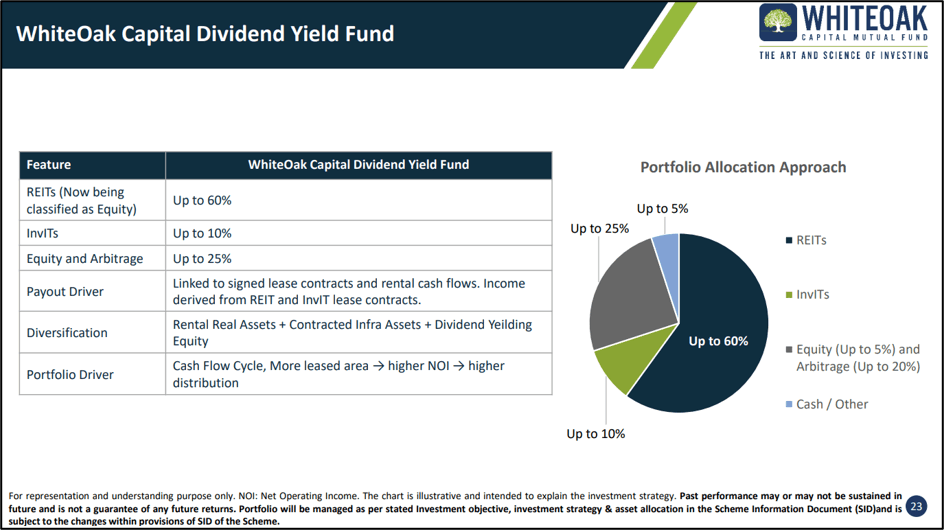
Source: Whiteoak Capital Dividend Yield Fund filings
Key Takeaways
Index Pure-Plays (Navi vs. Edelweiss): Both funds track the exact same underlying benchmark (Nifty REITs & Realty TRI). The primary differentiators between them will be their tracking error and final post-NFO Direct Expense Ratio (TER).
Active Flexibility (WhiteOak): WhiteOak is not an index fund. It uses a dividend-yield mandate with broad equity allocation, utilizing REITs (up to 60%) and InvITs (up to 10%) as cash-flow generation tools alongside dividend-paying stocks.
Tax Efficiency: All four funds compound rental distributions inside the fund structure, delaying tax liability until you redeem units (unlike direct REIT ownership, where payouts are taxed annually per your income tax slab).
Simply put, as an MFD, the following mapping can be referred:
Edelweiss, Navi, HDFC - "I want to invest in real estate - both REITs and realty companies."
Whiteoak - "I want an active portfolio with a dividend-yield orientation, and REITs/InvITs can be majority of it."
FAQs
Q: What is a REIT mutual fund and how is it different from buying REITs directly?
A: A REIT mutual fund pools investor money to buy units of listed REITs (and in some cases realty stocks) through a regular mutual fund account.
Q: Are REIT mutual funds taxed as equity funds in India?
A: Yes, following SEBI's decision to classify REITs as equity instruments for mutual fund purposes, funds maintaining the required equity-oriented allocation qualify for equity taxation. This means gains are treated as long-term capital gains (taxed at 12.5%) if held for more than 24 months, and short-term capital gains are taxed at your applicable slab rate if redeemed before that. Verify the specific equity qualification threshold for each fund in its Scheme Information Document before advising clients.
Q: Is the WhiteOak Capital Dividend Yield Fund the same as a REIT index fund?
A: No. WhiteOak Capital Dividend Yield Fund is an actively managed equity scheme, not an index fund. It can allocate up to 60% in REITs and up to 10% in InvITs, but the rest of the portfolio consists of dividend-yielding equities and arbitrage positions. Its benchmark is the BSE 500 TRI, not a REIT index. This makes it a broader, multi-asset dividend strategy rather than a pure REIT play.
Q: Can MFDs distribute these REIT mutual funds to their clients like regular equity funds?
A: Yes. Since these funds are structured as regular mutual fund schemes and registered with SEBI and AMFI, MFDs with a valid ARN can distribute them through standard transaction platforms. The commission and trail structure would follow the fund house's distributor agreement. MFDs should check each fund's commission disclosure in its addendum before recommending it to clients.
Disclaimer: The information provided in this discussion is strictly for educational and informational purposes and does not constitute professional financial, investment, legal, or tax advice. Mutual fund investments are subject to market risks, including the potential loss of principal, and past performance is not a reliable indicator of future results. All specific fund names, historical events, or financial metrics mentioned are for illustrative purposes only and should not be construed as recommendations to buy or sell any security. You are strongly advised to consult with your advisor or a qualified financial planner to assess your specific risk profile, tax bracket, and financial goals before making any investment decisions.