GIFT City Inbound Retail Funds (2026)

Two India-focused inbound funds are live at GIFT City as of July 2026: the Tata India Dynamic Equity Fund (IFSC) and the Sundaram India Mid Cap - GIFT. Both are USD-denominated retail schemes that let an NRI own Indian equities in dollars, and both are feeders into the AMC's proven onshore strategies. This guide compares what each one holds, what it costs, and who it fits, so you can place a client without opening two separate factsheets.
Why inbound funds suit an NRI
The appeal lies in the fact that the gains carry no capital gains tax in India, nothing is deducted at source, and the proceeds stay fully repatriable. On top of that, the money stays in dollars on the way in and out, so there's no rupee conversion and no forex spread, and holding the investment needs no PAN, no demat, and no Indian bank account. Resident Indians can't buy these funds at all, which tells you exactly who they were built for: the client living in Dubai or Singapore who wants India in their portfolio without the onshore paperwork.
For the full case, the tax mechanics, eligibility, funding routes and onboarding, refer clients to the NRI's guide to GIFT City. If you want the regulator, the IFSC framework and the plumbing behind all of it first, our pillar guide, GIFT City explained: a distributor's guide for 2026, is the place to start. This piece assumes that background and stays on the funds.
Live funds at a glance
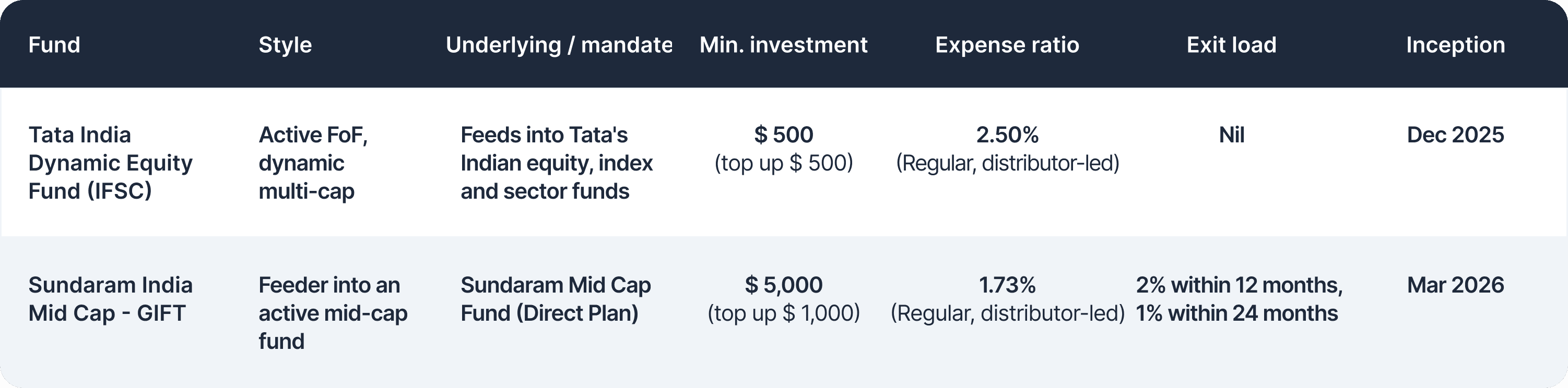
Two funds, two very different jobs. Tata is a low-minimum, all-in-one India allocation with no exit load. Sundaram is a higher-minimum, single-theme mid-cap bet with a two-year load window.
Tata India Dynamic Equity Fund (IFSC)
What it holds. This is a fund-of-funds that spreads a client's dollars across Tata's own Indian schemes rather than picking stocks directly. As of 28 February 2026, the core sat in the Tata Nifty 50 Index Fund at 48.83%, the Tata Mid Cap Fund at 9.99% and the Tata BSE Quality Index Fund at 9.80%. The satellite arm added the Tata Banking & Financial Services Fund at 10.05%, the Tata India Consumer Fund at 9.54% and the Tata Small Cap Fund at 8.55%, with the rest in cash. On a look-through basis the book is roughly 63% large-cap, with the balance in mid and small caps. Its biggest underlying stock exposures were HDFC Bank at 7.54%, ICICI Bank at 5.66% and Reliance Industries at 4.10%, and banks were the top sector at 23.29%. For the full underlying holdings and current NAV, see the fund's monthly factsheet on the Tata GIFT City page.
Worth noting: with nearly half the fund in a single Nifty 50 index tracker, the "dynamic" part of the name rides on the smaller satellite sleeve, not the core. The client is buying a mostly large-cap India allocation with a tactical tilt on top.
Structure and managers. It's an open-ended inbound feeder scheme registered with the IFSCA and run by Tata Asset Management's IFSC branch, benchmarked to the Nifty 500 TRI. It has the distinction of being the first retail inbound mutual fund cleared at GIFT City, with IFSCA approval in September 2025. The fund manager is Aditya Shanker, who has run it since the 1 December 2025 launch.
Costs and exit. There are two share classes, both starting at USD 500. Class A is the direct route at a 1.75% expense ratio; Class B is the distributor and advisor-led route at 2.50%. That 0.75% gap is your commission-bearing option, so an NRI client who wants you managing the relationship goes into Class B. There's no exit load, which makes this the more liquid of the two live funds.
Performance so far. The fund only began investing on 1 December 2025, so there's no track record worth quoting yet, and any early move says more about where Indian equities happen to be than about the fund itself. What you're really selling is the allocation discipline and the pedigree of the underlying Tata schemes, not a return line. Set that expectation with the client up front and the first quiet quarter won't rattle them.
Distributor take. This is the natural default for an NRI who wants "India, handled for me" in one ticket. The USD 500 minimum lets you start a client small, the no-load structure keeps the exit conversation clean, and the multi-cap mandate means you skip the large-versus-mid-cap debate on day one. For a first-time NRI investor testing GIFT City, this is the low-friction entry point.
Sundaram India Mid Cap - GIFT
What it holds. This one is a single-strategy bet, not a spread. It's a USD-denominated feeder that channels almost all of its assets into the Direct Plan of the Sundaram Mid Cap Fund, an onshore scheme running since 2002. The underlying manager uses a Growth at a Reasonable Price approach and leans into consumer discretionary, financials, and structural themes like manufacturing, cement and telecom. So the client is buying two decades of a specific mid-cap process, delivered in dollars. For the latest holdings and figures, see the fund's factsheet on Sundaram's GIFT City page.
Structure and managers. It's an open-ended USD-denominated retail scheme registered with the IFSCA, run from Sundaram's GIFT City branch and benchmarked to the Nifty Midcap 150 TRI. Units were offered at USD 10 at launch. The fund manager is Saurabh Kapadia. Sundaram Asset Management runs roughly USD 9.6 billion (about ₹86,245 crore) as of early 2026, so the parent is established even though this wrapper is new.
Costs and exit. The minimum is USD 5,000 with top-ups of USD 1,000, a much higher bar than the Tata fund. Sundaram's product note doesn't publish a single headline all-in expense ratio; the cost is the GIFT scheme's own fee stacked on the underlying Sundaram Mid Cap Direct Plan, which itself runs about 0.91%. Ask for the current combined figure in writing before you place a client. The exit load has teeth: 2% if redeemed within 12 months and 1% between 12 and 24 months, so this is money that should sit for at least two years.
Performance so far. The GIFT scheme launched in March 2026, so its own numbers can't tell you much yet. The record that matters belongs to the underlying Sundaram Mid Cap Fund, which has compounded for more than two decades onshore. That history sits in a different vehicle and in rupees, though, so use it as context for the strategy you're buying, not as a promise for this dollar wrapper.
Distributor take. This is a satellite holding for a client who already wants India mid-cap exposure and can leave the money alone. The higher minimum and the two-year load window make it wrong for anyone who might need liquidity, and right for a conviction allocation. One eligibility flag worth catching early: US and Canada-based NRIs are generally shut out on FATCA grounds, so confirm the client's jurisdiction before you pitch it.
How to choose between them
Start with what the client wants to own. Tata is a whole-of-market, do-it-for-me allocation across large, mid and small caps plus sectors. Sundaram is a single, pointed mid-cap bet. Match that to how much concentration the client can stomach.
Then look at entry friction and holding period. The Tata fund starts at USD 500 with no exit load, so it suits a smaller or first-time NRI client and anyone who values liquidity. Sundaram's USD 5,000 minimum and two-year load window suit a larger allocation the client won't touch for a while.
Then costs. On the Tata fund you're choosing between a clean 1.75% direct and 2.50% distributor-led. On Sundaram, the all-in figure isn't spelled out in the product note, so pin it down before recommending.
The tax and repatriation case is identical across both, and it's the same one you already make for any inbound scheme: no TDS, no LRS or TCS in play, dollars in and out. The NRI's guide to GIFT City has the full detail; on the fund choice itself, tax is a wash between these two.
One shared caveat for both: the track records are months old. What you're really selling is the AMC, the underlying strategy, and the USD wrapper, not a performance line.
FAQs
Q: How many inbound retail funds are live right now?
A: As of July 2026, two India-focused retail inbound funds are live: the Tata India Dynamic Equity Fund (IFSC) and the Sundaram India Mid Cap - GIFT. Other inbound India products, such as offerings from Mirae Asset and ICICI Prudential, are restricted or accredited-investor schemes with far higher minimums, not retail funds. More retail launches are expected through 2026.
Q: What's the practical difference between the Tata and Sundaram funds?
A: The Tata fund is a dynamic fund-of-funds spread across large, mid and small caps with a USD 500 minimum and no exit load. The Sundaram fund is a focused mid-cap feeder with a USD 5,000 minimum and a load of 2% within 12 months and 1% within 24 months. Tata suits a broad, liquid core holding; Sundaram suits a patient mid-cap satellite.
Q: What does each fund cost?
A: The Tata fund charges 1.75% for the direct Class A and 2.50% for the distributor-led Class B. Sundaram doesn't publish a single all-in expense ratio in its product note; the cost is the GIFT scheme's own fee on top of the underlying Sundaram Mid Cap Direct Plan, which runs about 0.91%. Get the combined figure from the fund house before placing a client.
Q: Can US and Canada NRIs invest in these two funds?
A: Eligibility varies by fund. US and Canada NRIs are generally excluded from the Sundaram fund on FATCA grounds. Confirm the specific fund house's position for the client's jurisdiction before pitching, and note that US persons should weigh their own PFIC reporting.
Q: Which fund is better for a first-time NRI investor?
A: For most first-time clients, the Tata India Dynamic Equity Fund is the easier start: a USD 500 minimum, no exit load, and a diversified multi-cap mandate rather than a single-segment bet. The Sundaram fund makes more sense once a client specifically wants mid-cap exposure and can commit for at least two years.
If you advise NRI clients across GIFT City and want to place these funds without stitching together separate factsheets and reporting, get a consolidated view see how Creso helps MFDs run a modern practice.