Which International Mutual Funds Are Open for SIP? (July 2026)

As of July 10, 2026, just one international mutual fund in India is open for a fresh SIP: the Baroda BNP Paribas Aqua Fund of Fund. Every other overseas scheme has either stopped new SIP registrations or shut fresh money entirely, after Edelweiss, PGIM, and Franklin Templeton pulled back their feeder funds this week.
If you distribute mutual funds, you already feel this one land. A client asks to start a small S&P 500 or Nasdaq SIP, you open the usual international fund of funds, and the registration button is gone. This week made it worse. Three more fund houses closed their doors within 48 hours, and the list of what still accepts new money is now almost empty.
Here's the current status, who did what and when, and the one route that isn't boxed in by the same limit.
Which International Mutual Funds Are Open for SIP Right Now?
The honest answer for a client conversation today: treat the domestic international fund category as closed for fresh SIPs. Only the Baroda BNP Paribas Aqua Fund of Fund is still taking new SIP registrations and lump sum money, and it is a narrow water-and-utilities theme, not a broad global index. It suits a small set of investors, not the client who just wants plain S&P 500 exposure.
For scale on how fast this shrank: Value Research counted 12 of roughly 66 international schemes still accepting fresh SIPs as of June 4, 2026. After the July 9 and July 10 suspensions from PGIM, Franklin, and Edelweiss, that number is effectively down to one.
The Full AMC Status List (July 10, 2026)
I keep this table pinned because it changes almost weekly. Three buckets matter: what takes new money, what only honours existing SIPs, and what has frozen even the SIPs already running.
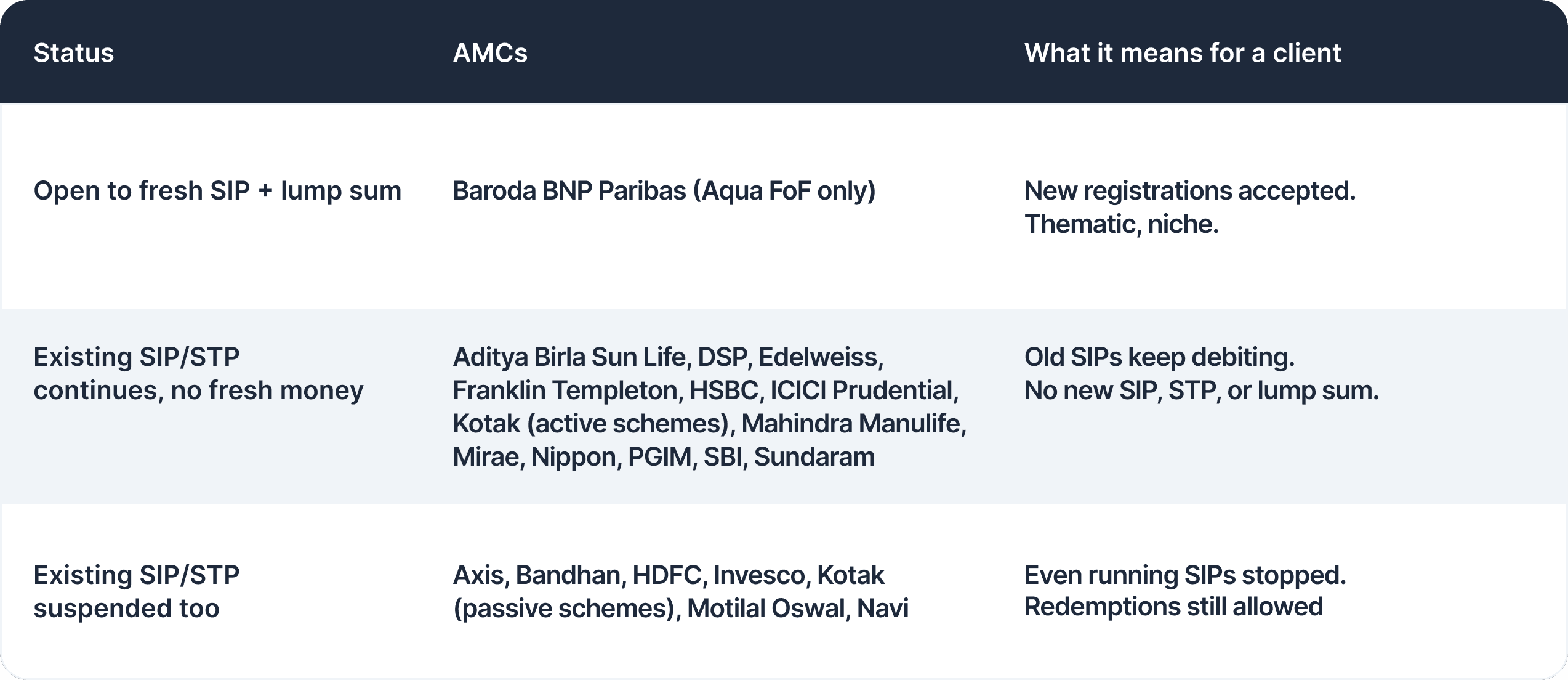
A few dates worth quoting to clients, because they show this is a rolling squeeze and not a one-off:
Nippon India stopped fresh subscriptions, switch-ins, and new SIP/STP registrations from April 21, 2026.
Axis did the same from May 6, 2026.
Franklin Templeton first capped its Asian Equity and U.S. Opportunities feeder funds at ₹5 lakh lump sum and ₹50,000 SIP per PAN per month on May 18, 2026, then suspended fresh SIP/STP from July 9, 2026.
PGIM India suspended fresh subscriptions across its Global Equity Opportunities, Emerging Markets Equity, and Global Select Real Estate FoFs from July 9, 2026.
Edelweiss suspended fresh SIP/STP into its overseas funds effective July 10, 2026. Lump sum was already shut.
Why This Keeps Happening: The $7 Billion Cap
The closures are not a fund manager problem. They are a plumbing problem.
SEBI and RBI cap the entire Indian mutual fund industry at $7 billion for direct overseas equity investment, plus a separate $1 billion for global ETFs. There is also a $1 billion per-AMC ceiling, which is why a fund house can shut its whole international lineup on one day instead of one scheme at a time. Both limits were set in 2008 and have never been raised, even as the industry grew roughly tenfold.
The industry breached that $7 billion ceiling in January 2022. Since then, AMCs run a headroom lottery. New money gets in only when existing investors redeem, or when a weak month in global markets shrinks the rupee value of the portfolio and frees a little room. AMFI directs fund houses to reference their February 1, 2022 exposure, and the gap between that and today is all the headroom a scheme has.
For perspective, the total mutual fund industry AUM crossed ₹81 lakh crore by mid-2026. The $7 billion overseas allowance is roughly ₹66,000 crore, under 1% of what the industry manages. That is the size of the pipe every global SIP has to squeeze through.
AMFI has been pushing back. CEO Venkat Chalasani has said the body will renew its appeal to RBI, SEBI, and the government to raise the cap, arguing that mutual fund redemptions flow back into India automatically, which makes the route safer for the capital account than direct remittances. Cafemutual's reporting on the same effort calls the cap "decade-old" and notes it has not moved. Outlook Money reports the timing stings more because domestic benchmarks were flat to negative through the first half of 2026, exactly when clients wanted to diversify abroad.
What the July Suspensions Mean for Your Clients
Two things break for a serious investor when the category closes like this.
First, you cannot dollar-cost average. A client who wants to build S&P 500 exposure over three years cannot rely on a SIP that might vanish next quarter. Domestic international FoFs as a primary global vehicle are not recommended exactly for this reason. No fund manager can engineer around an industry cap.
Second, the timing is cruel. Fresh money is locked out right when several global markets are running, so the clients who most want diversification are the ones who can't get it. Even the global ETF route hit its own $1 billion wall, so pointing clients to index ETFs instead of FoFs doesn't solve it either.
So when a client asks "what do I do now," you need a real answer, not "wait and watch."
The Route That Isn't Capped: GIFT City
GIFT City sidesteps the $7 billion cap completely, because it isn't part of SEBI's domestic mutual fund universe at all. It sits physically in Gandhinagar, Gujarat, but operates as an offshore jurisdiction under a separate regulator, the International Financial Services Centres Authority (IFSCA). For more on this, you can read GIFT City explained.
Three differences do the work:
No industry cap applies. Funds domiciled in the IFSC fall outside SEBI's overseas ceiling, so the $7 billion limit doesn't touch them.
Money moves through the LRS. Resident Indians remit dollars using RBI's Liberalised Remittance Scheme, up to $250,000 per person per financial year, a completely separate allowance from the fund industry's quota.
The fund is USD-denominated. Capital sits in dollars from the point of investment, so there is no internal rupee conversion diluting the exposure.
Retail access here is new. The IFSCA (Fund Management) Regulations, 2025 opened a retail scheme category with minimums as low as $5,000, additional purchases in $500 steps, and no lock-in. PPFAS launched its S&P 500 and Nasdaq 100 fund-of-funds on this structure in early 2026, and DSP runs an actively managed Global Equity Fund on the same rails. As of July 2026, five retail outbound schemes are live across four AMCs, including a Marcellus global fund and an Edelweiss Greater China fund.
Here is how the two routes compare.
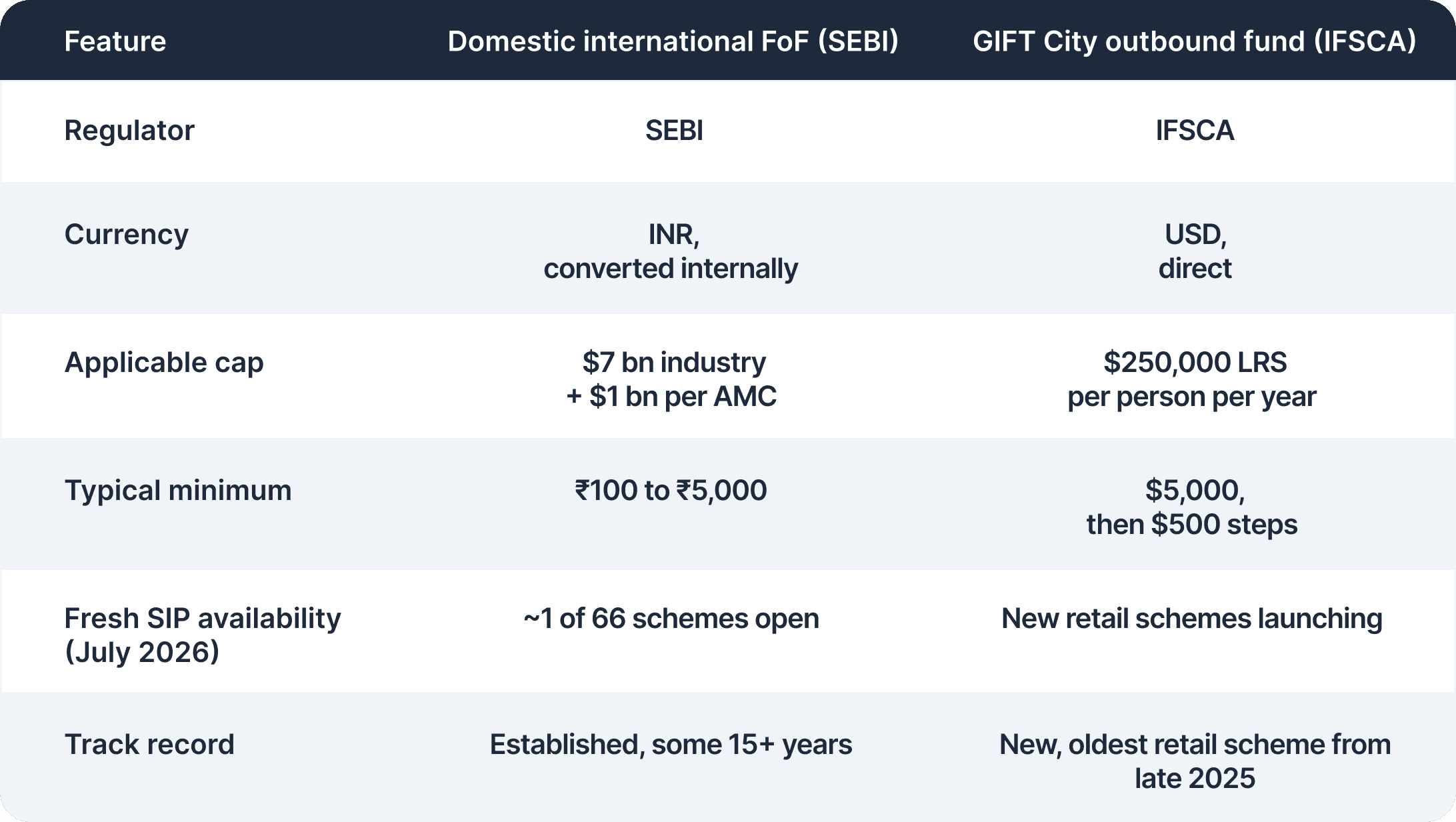
It is not a like-for-like swap. GIFT City retail schemes are young, none has a multi-year record yet, and liquidity is thinner than a mainstream SEBI-regulated fund. But for a resident client who wants dollar exposure without chasing whichever FoF happens to be open this month, it is now the realistic answer. Moreover, these funds are run by the same old trusted AMCs namely, PPFAS, DSP, Edelweiss, etc. The client conversation, the pushback you'll hear, and the tax treatment on both sides are in our GIFT City distributor playbook (Coming soon). For a fund-by-fund breakdown with costs and structure, see our guide to GIFT City outbound retail funds (2026).
What to Tell a Client Today
Don't wait for a reopening window that may last a day. If a client has a genuine dollar-exposure goal and the ticket size to clear $5,000, walk them through GIFT City now and set expectations on the short track record. If they can't clear the minimum, be straight that broad global SIP access is simply on hold at the moment, and revisit when AMFI's petition actually moves the cap. There's no confirmed timeline on that.
For the clients already running international SIPs, check which bucket their AMC sits in. If it's in the "existing suspended" group (Axis, HDFC, Motilal Oswal and the others above), their SIP has already stopped debiting and they may not have noticed.
FAQs
Q: Which international mutual funds are still open for fresh SIP in July 2026?
A: As of July 10, 2026, only the Baroda BNP Paribas Aqua Fund of Fund accepts fresh SIP registrations and lump sum investments, and it is a narrow thematic scheme. Every other domestic international fund has either stopped new SIPs or frozen fresh money entirely.
Q: Why did Edelweiss, PGIM, and Franklin suspend their overseas fund SIPs this week?
A: All three hit the headroom limits that flow from the industry's $7 billion overseas cap and the $1 billion per-AMC ceiling. PGIM and Franklin suspended fresh SIP/STP effective July 9, 2026, and Edelweiss followed on July 10, 2026. Existing SIPs at these houses continue for now.
Q: Will my client's existing international SIP keep running?
A: It depends on the AMC. Houses like Aditya Birla Sun Life, ICICI Prudential, SBI, and Nippon are honouring existing SIPs while blocking new ones. Others, including Axis, Bandhan, HDFC, Invesco, Motilal Oswal, and Navi, have suspended even existing SIPs. Redemptions remain allowed in all cases.
Q: Why is the whole international mutual fund category closing at once?
A: SEBI and RBI cap the entire industry at $7 billion for direct overseas equity plus $1 billion for global ETFs, limits set in 2008 and never raised. The industry breached the ceiling in January 2022, so fund houses can only accept new money when existing investors redeem and free up headroom.
Q: How is a GIFT City outbound fund different from a regular international fund?
A: GIFT City funds are regulated by the IFSCA, not SEBI, operate in US dollars, and use the $250,000 LRS annual limit instead of the mutual fund industry's overseas cap. That is why they keep launching while domestic feeder funds stay shut.
Q: What's the minimum to invest in a GIFT City outbound retail fund?
A: Most retail-grade outbound schemes, such as the PPFAS S&P 500 and Nasdaq 100 fund-of-funds, start at $5,000, with additional purchases in $500 increments and no lock-in.
Q: Will SEBI or RBI raise the $7 billion cap soon?
A: There is no confirmed timeline. AMFI has repeatedly petitioned regulators to raise it, most recently in mid-2026, arguing that mutual fund redemptions return to India automatically and carry less capital-account risk than direct remittances. As of this writing the cap is unchanged.
If you want one dashboard to track client SIPs, GIFT City allocations, and every AMC's open-or-closed status without juggling logins, take a look at what Creso offers for MFDs.