GIFT City: An MFD's Client Playbook (2026)

GIFT City gives an MFD two client conversations from one financial zone: the resident Indian who wants global markets in dollars, and the NRI who wants Indian markets without the onshore paperwork. This playbook covers how to introduce each one, the pushback you will hear, and how the tax works on both sides, so you can answer with conviction, not guesses.
A brief overview before diving deep: Outbound means a resident sending money out of India to invest globally through the International Financial Services Centre (IFSC) at GIFT City. Inbound is the mirror image: non-resident money coming into Indian assets, in dollars. The two routes share a zone and a regulator, IFSCA, and almost nothing else. Different clients, different rules, different tax. For the regulator, the framework and the plumbing behind the zone itself you can read GIFT City explained: a distributor's guide for 2026, this piece focuses on the client conversation.
Part 1: Introducing GIFT City and handling the pushback (Outbound and Inbound)
How to introduce GIFT City outbound to a resident client
The case for going global comes first. A portfolio built entirely in India rides on one economy and one currency, and a rupee that depreciates 3-4% a year on average quietly eats into long-term returns. An allocation to global markets adds the world's largest companies to the portfolio and puts a part of the client's wealth in dollars, which also builds a natural reserve for future dollar expenses like a child's education abroad.
Once the why is settled, the how narrows quickly. There are three ways to invest globally from India. Regular international mutual funds are mostly shut for fresh money because the industry hit a regulatory ceiling on how much it can send abroad. A foreign broker works, but brings foreign KYC and heavier tax paperwork every single year. GIFT City is the route that stays open and simple: an Indian financial zone treated as offshore for investment purposes, where the client holds US stocks and global funds in dollars, through an Indian mutual fund house, under the same rules that already let residents send money abroad.
For more details and the full side-by-side of all three routes, the feeder funds vs IBKR vs GIFT City comparison is the companion piece, and to know which GIFT retail funds are live refer Outbound Retail Funds guide.
Outbound: the questions resident clients ask, and the best way to answer them
"We already do feeder funds, why change?"
Feeder funds are a great tool when they are open. Right now, for new investments, most of them aren’t, because of the industry wide regulatory ceiling. Domestic international funds and feeder funds sit under SEBI's $7 billion industry-wide overseas investment cap. That cap is close to full, which is why Axis, Nippon India, Franklin Templeton and Kotak suspended or capped fresh inflows into their international funds through April and May 2026. GIFT City outbound funds are regulated by IFSCA, not SEBI's mutual fund rules, so they sit outside that cap entirely and keep taking fresh money.
"Why not just use IBKR or a foreign broker?"
If you want to trade the whole US market yourself, a foreign broker wins on breadth. It opens up 10,000+ US securities. GIFT City is narrower: through Unsponsored Depository Receipts on NSE International Exchange, it covers around 50 large US names like Apple, Amazon and Microsoft, plus GIFT-domiciled funds, with more ETFs on the exchange's expansion list.
But breadth is where the foreign broker's advantage ends, and compliance is where it unravels. A foreign brokerage account means foreign KYC, and every year you report those holdings in Schedule FA of your ITR, with per-trade profit and loss. That is where filings get painful. GIFT City runs on Indian KYC and an Indian broker, and for certain India-domiciled fund structures, Schedule FA may not even apply (worth confirming with your CA). Setup takes 3 to 7 days on the GIFT side, against 7 to 21 for a foreign broker.
There's a trust dimension too. GIFT City keeps your money with an AMC you've invested through for years, not an international broker whose name you've never heard.
And the incentives line up: the foreign-broker route often pays the advisor on transaction brokerage, so the more you trade, the more they make. A GIFT City distributor earns a small recurring trail on what you hold, the same way your mutual fund distributor does. They're paid to keep you invested, not to keep you trading.
"Do I need to open a dollar account or a GIFT City account first?"
No. You don't need any new account to start. Investments in GIFT retail funds can be made by remitting straight from the client's regular INR bank account, through an authorised dealer bank using Form A2, and platforms like Creso can make the entire onboarding process simpler. A GIFT-based or USD account is not needed to invest or redeem. The client bears the INR-to-USD conversion cost and bank charges, the same as any overseas payment.
A resident who already holds a foreign bank account can also fund the investment from there, provided they hold a valid PAN and stay within LRS guidelines. On exit, proceeds can be repatriated to an INR account in India or paid into a USD account if the client has one.
"Isn't the 20% TCS a dealbreaker?"
Not once you see what it actually is. TCS is Tax Collected at Source, an advance-tax deposit the bank collects and hands to the government in your name. It only kicks in on what you send above ₹10 lakh in a year, and every rupee of it comes back to you, either as a refund or as credit against your total tax bill when you file. So the 20% isn't a cost, it's a deposit. The only real effect is that some cash sits with the tax department for a few months until your ITR is processed.
We can plan around that in two ways. First, we stagger how you remit, so you stay under or near the ₹10 lakh threshold where it makes sense. Second, if you're salaried, you file Form 122 with your employer, the form that replaced Form 12BAA in April 2026, and the TCS is set off against your salary TDS through the year. Handled that way, it barely leaves your pocket.
"Will my money get stuck? Can I actually get it back?"
Money invested through LRS is fully accessible, your money is not locked anywhere. When the client sells, redemption proceeds, net of charges, typically reach the client within about 7 business days, paid to an INR account in India, a USD account, or an offshore account, as long as the account is in the investor's own name. Redemptions run on FIFO where units were bought on different dates, which matters for exit-load and holding-period math on staggered purchases.
The one compliance point worth flagging: under RBI's LRS framework, foreign exchange that is realised and not reinvested generally has to be repatriated and surrendered to an authorised dealer within 180 days, i.e. 6 months, per FEMA Regulation 7 (2015), which means if you sell and decide not to reinvest, you bring the cash home within about six months. That is a housekeeping rule, not a lock-in; income earned abroad can be retained and reinvested.
"Won't this get taxed twice, once here and once there?"
No. Your gains are taxed once, not twice. For these retail GIFT City funds, the fund pays its own capital gains tax before declaring NAV, so the price you redeem at is already net of tax and you file nothing separately on exit. The TCS you paid going in isn't a second tax either, it's a deposit you get back as credit against your tax bill. So there's no stacking: one tax, paid once by the fund, plus a deposit that comes back to you.
How to introduce GIFT City inbound to an NRI client
The pitch flips completely for a non-resident. Inbound GIFT City funds are USD-denominated schemes, regulated by IFSCA, that invest into Indian markets, so clients can hold Indian equities in dollars. NRI clients can get India in their portfolio without the Indian paperwork. For them, the gains carry no capital gains tax in India, nothing is deducted at source, the proceeds stay fully repatriable–meaning the money lands back in your account abroad in dollars, and the investment needs no PAN, no demat, and no Indian NRE/NRO bank account. Resident Indians cannot buy these funds at all, which tells you exactly who they were built for. This could be the cleanest India allocation a client can hold from Dubai or Singapore.
For more detail, you can read The NRI's guide to GIFT City, and for the list of live funds, refer to the inbound retail funds guide that compares them on cost and strategy.
Inbound: the questions NRI clients ask, and the best way to answer them
"Why not keep using regular Indian mutual funds through my NRE account?"
India mainland funds still work, but they carry the frictions inbound GIFT funds were built to remove. An Indian equity fund deducts tax at source, needs an NRE or NRO account, converts everything through rupees (leading to conversion losses), and widely restricts US and Canada investors. An inbound GIFT fund charges no capital gains tax in India, deducts nothing at source, runs in dollars both ways, and its fees are exempt from GST.
"Do I need a PAN, a demat, or an Indian bank account?"
No demat and no Indian bank account. A PAN is not mandatory for these funds, only recommended if the client already holds one. The clean funding routes are a foreign bank account or a GIFT City (IFSC) account (an NRE account can be linked if desired). Your foreign bank account funds it, and the money comes back to the same account when you sell.
"Can I use GIFT to invest globally too, like my cousin in Mumbai does?"
Yes, but not recommended. Outbound rides on the RBI's Liberalised Remittance Scheme, which is resident-only, and its appeal is a lighter-taxed route abroad. Neither applies to you: India doesn't tax your foreign gains anyway, and your money is already offshore. On top of that, the same global funds are usually cheaper and wider through your own US brokerage, UK ISA, or Gulf platform; routing back through India only adds cost. Outbound is the resident's tool. Inbound is the NRI's.
Part 2: The taxation and operational reality
This part is the mechanics: where tax lands, at what rate, and what you carry operationally on each side. Outbound and inbound run on completely separate tax logic
Outbound: how a resident client is taxed
Give the client the map before the rates. Money moves through five stages, and tax can appear at two of them.
Rupees sit in India.
LRS remittance sends dollars abroad (tax event: TCS).
The GIFT fund receives the dollars.
The fund invests and earns returns. It pays tax on its own gains and dividends internally, on the fund's PAN, not the client's.
Redemption returns money to the investor. The NAV is already post-tax, so there is no separate capital gains filing.
Two real tax points: sending money out, and the fund paying its own tax before it pays you. Walk a client down this list and the double-tax worry falls away.
Stage 1: The LRS limit
Part 1 covered why LRS matters, so here are just the two numbers a client needs. A resident individual can remit up to USD 250,000 per financial year, tracked at PAN level across all banks, resetting every April 1 (RBI LRS Master Direction). GIFT investments count against this same ceiling, so they compete with any other foreign spending the client does.
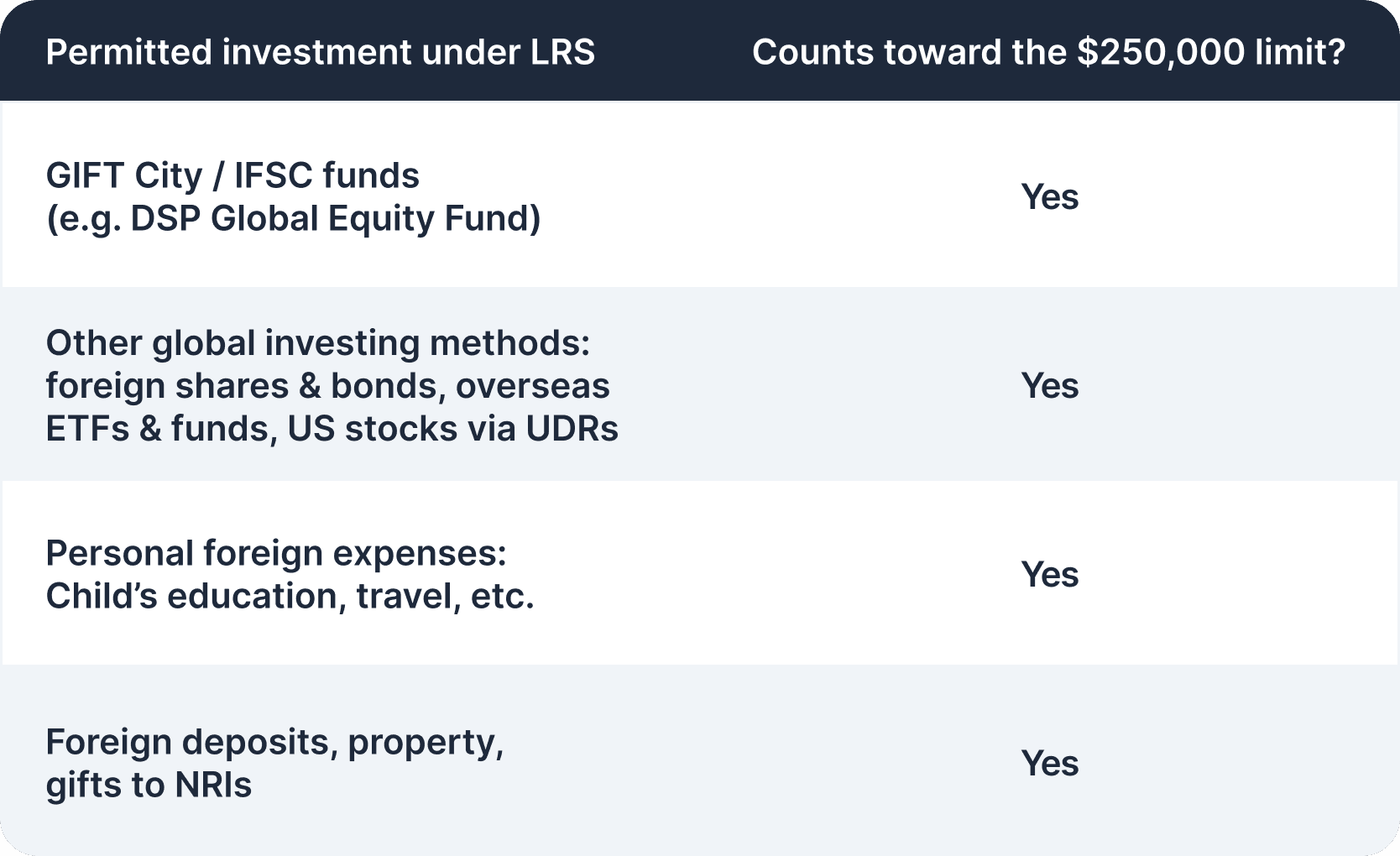
Three points most distributors miss:
The limit is per person, not per family. A couple has $500,000 combined and a family of four has $1 million. Fund houses accept consolidated family remittances for a single investment, provided every member is a blood relative and each complies with LRS.
Capital already abroad doesn't touch the limit. Money a client has already invested overseas can move into a GIFT fund without using fresh LRS headroom, because the $250,000 ceiling applies to new remittances out of India, not to funds already sitting offshore.
Individuals aren't the only eligible investors. Companies, LLPs and registered partnership firms can invest through the Overseas Portfolio Investment (OPI) route, capped at 50% of net worth per the last audited balance sheet. That one opens a conversation with business-owner clients sitting on idle treasury.
Stage 2: The 20% TCS in practice
We’ve established that TCS is a refundable deposit, not a cost. What matters here is the cash-flow gap and how you plan around it.
TCS applies at 20% on investment remittances above ₹10 lakh in a financial year, with the threshold raised from ₹7 lakh effective April 1, 2025 (Budget 2025). The first ₹10 lakh carries none. The bank issues Form 27D as the collection certificate, which the client keeps for filing.
A worked example makes it concrete. A client remits ₹20 lakh in FY2025-26. The first ₹10 lakh attracts no TCS; the next ₹10 lakh attracts 20%, so ₹2 lakh is collected. That ₹2 lakh comes back at ITR filing. So on a ₹20 lakh remittance, everything is invested except ₹2 lakh, which returns at filing. That is the entire "20% problem."
Three planning levers: stagger remittances near or below ₹10 lakh for smaller portfolios; split a large allocation across two financial years, since the threshold resets April 1; and build gradually, which fits the LRS multi-year logic anyway.
Stage 3: Fund-level tax (the stage clients don't see)
Between remittance and redemption, the fund itself is taxed, and for most retail structures the client never has to track it.
Retail GIFT outbound funds like the DSP Global Equity Fund (launched June 2025, $5,000 minimum) are commonly set up as determinate irrevocable trusts. The trustee pays tax at the fund level as a representative assessee before declaring NAV, so the NAV the client redeems at is already net of that tax. GIFT trades also carry no STT, CTT or GST.
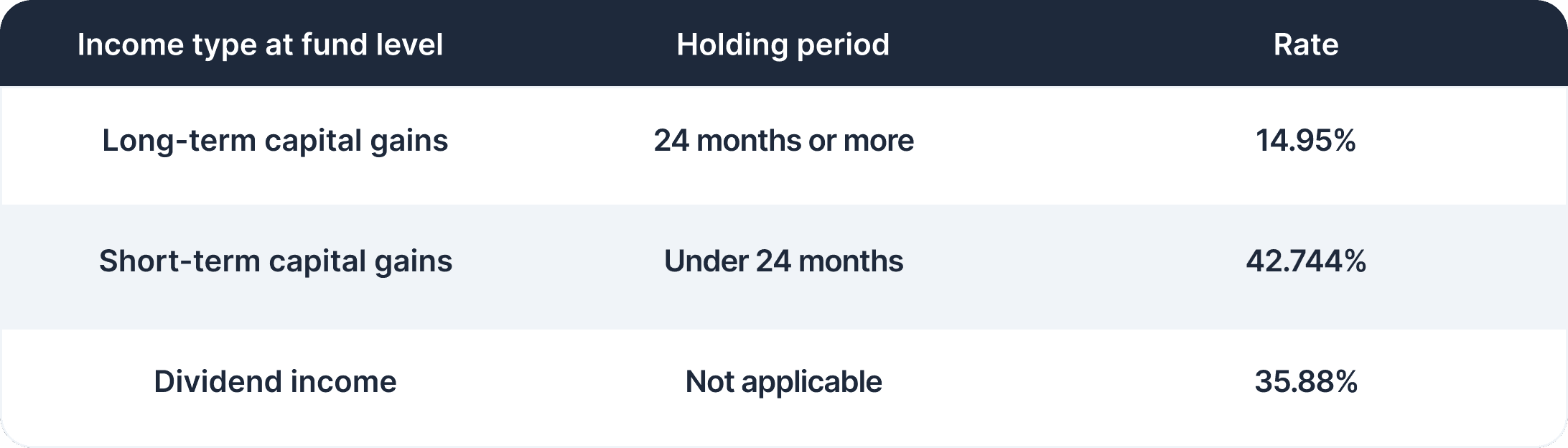
Three mechanics that catch distributors out the first time.
While the client holds, the tax sits on the fund's PAN, not theirs. The fund pays tax on its own trading before it declares NAV, so during the holding period nothing shows against the investor. There is no annual tax filing for them on these gains.
When the client exits, there is no TDS on redemption or distributions. Because the tax was already settled inside the fund, the investor is not taxed again at the point of sale. Redemption proceeds come to them clean.
Churn does not appear on the client's return, but it is not free. The fund pays tax on its own trading gains, and that cost shows up as NAV drag rather than a separate bill. Same cost to the client, just carried inside the fund.
Stage 4: Capital gains when the resident exits
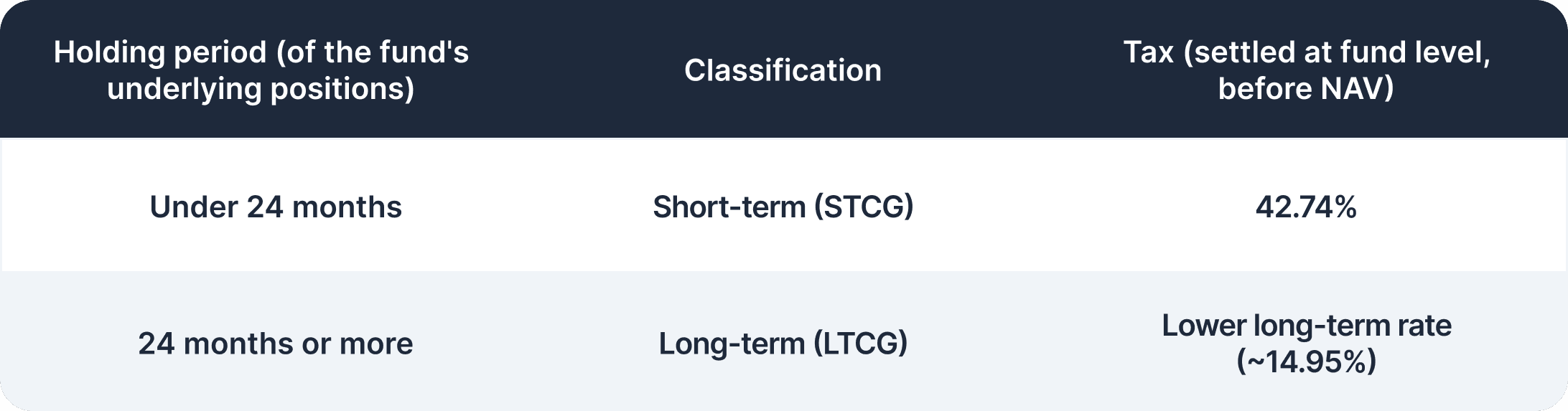
Two things to keep telling clients. First, a fund that trades heavily inside 24 months carries real NAV drag from the 42.74% short-term rate, which is exactly why longer holds and exit loads (DSP's is 1% within two years) are built into the fund design.
Second, currency still cuts both ways: returns are in dollars, so the rupee outcome moves with USD/INR independently of performance, but unlike the direct IBKR route, rupee depreciation doesn't create a separate taxable gain at the investor level here.
Inbound: how an NRI client is taxed
The inbound map is shorter. There's no LRS, which is resident-only, and no TCS, which is a resident-only charge on LRS remittances.
What the NRI actually faces comes down to two lines. In India via IFSC: nothing on gains. No capital gains tax and no TDS on inbound GIFT retail funds, and fund fees are GST-exempt. Compare the India mainland route, where NRE/NRO equity and debt funds withhold between 12.5% and 30% depending on the holding. At home: the DTAA decides. UAE clients typically face nothing; UK and Singapore clients follow home rules with treaty credit; US persons need a PFIC analysis first.
A worked example: an NRI in Dubai places $10,000 in an inbound GIFT equity fund. No TDS, no rupee conversion, full proceeds repatriable on exit. The same $10,000 in an India mainland equity fund attracts 12.5% LTCG above ₹1.25 lakh, has tax deducted at source, and needs an NRE or NRO account.
Lead with the caveats, because they're what clients underweight. These funds carry no DICGC deposit insurance, the IFSCA framework is younger than mainland regulation, and cost is the most underrated risk: a 3% entry load plus a high expense ratio can erase a real slice of the tax advantage, so read the benefit net of fees.
The distributor questions: empanelment and commissions
These three come from distributors rather than clients, and the answers are more encouraging than most expect.
Can I sell these with an India mainland ARN?
Yes. GIFT fund houses empanel existing AMFI-registered distributors directly through their IFSC entities. No separate exam, no net-worth threshold. Each AMC runs its own process, so empanelment is per fund house, not one industry-wide registration. Full IFSCA distributor registration exists too, but mainly matters for banks and larger firms. With Creso, you don't need to worry about that as we take care of the empanelment.
How do commissions work?
IFSC AMCs pay commissions in USD, which can be remitted to the distributor's INR account. Fund houses usually recognise three categories: distributors registered in GIFT City, AMFI-registered distributors with a GSTIN outside GIFT, and AMFI-registered distributors without a GSTIN.
What about the GST on my commission?
It depends on where you sit. A GST-registered distributor supplies services to an SEZ unit and can either supply under a Letter of Undertaking without paying IGST, or pay IGST and claim the refund. An India mainland distributor not registered under GST attracts no GST on the transaction. Confirm the treatment with your CA when you empanel.
How a platform makes the operational side simpler
Here's the part clients never see but you feel daily. On the outbound side it's remittance timing, TCS credit tracking, and holding-period math for each tranche. On the inbound side it's empanelment with IFSC-registered AMCs, jurisdiction checks, and folio paperwork through CAMS GIFT City. On both sides, it's keeping GIFT holdings visible next to the client's domestic book so reviews actually make sense.
The friction sits with you: one client's rupee SIPs, feeder holdings and GIFT dollar positions spread across three portals and a spreadsheet. That's the gap platforms like Creso close. Creso runs the core of an MFD's practice, transactions via BSE StAR MF, consolidated portfolio reporting across schemes and family members, and client communication, so a growing GIFT conversation sits inside the practice rather than bolted on beside it.
FAQs
Q: Are GIFT City outbound fund gains tax-free for a resident Indian?
A: No. A resident is taxed in India on global income, so outbound gains are taxable. The fund-level rate is 42.74% on short-term gains (positions held under 24 months) and a lower long-term rate (around 14.95%) at 24 months or more, computed on the fund's holding period, not the client's. The tax-free treatment people cite applies to NRI inbound funds, not resident outbound.
Q: Are inbound GIFT City fund gains taxable in India for an NRI?
A: No. Capital gains from inbound GIFT City retail funds carry no capital gains tax in India for a non-resident, and no TDS is deducted at source. Fund fees are also exempt from GST.
Q: What is the LRS limit for GIFT City investments?
A: A resident individual can invest up to USD 250,000 per financial year under the RBI's Liberalized Remittance Scheme, tracked at PAN level and reset every April 1. There is no separate limit for GIFT City. These investments count toward the same $250,000 ceiling, alongside any other foreign remittance the client makes.
Q: Is the 20% TCS on GIFT City investments refundable?
A: Yes. TCS is advance tax collected by the bank and credited to the client's PAN, not a separate cost. It applies only on investment remittances above ₹10 lakh in a financial year and is fully refundable or adjustable against total tax when the client files their ITR. It does not apply to NRIs at all.
Q: Does an NRI need a PAN, demat, or Indian bank account for inbound GIFT funds?
A: No. A PAN is not mandatory, and no demat or Indian bank account is needed. Funds are bought in foreign currency from a foreign or IFSC bank account, without the need of NRE/NRO accounts.
Q: Do I need to declare GIFT City investments in my ITR?
A: For a resident and ordinarily resident taxpayer, outbound GIFT City holdings may need to be disclosed as foreign assets under Schedule FA of the ITR, since the IFSC is treated as offshore. Some India-domiciled trust-based fund structures may not require it, so confirm the specific fund's position with a CA. NRIs investing in inbound funds do not file Schedule FA for these.
If you want to run a modern MFD practice where global conversations like this one fit into a single, clean workflow instead of scattered tools, take a look at what Creso offers for MFDs.