You’ve Checked The Returns, But Have You Checked The Taxes? (Part 2: Making Smarter Choices)
Nov 19, 2025
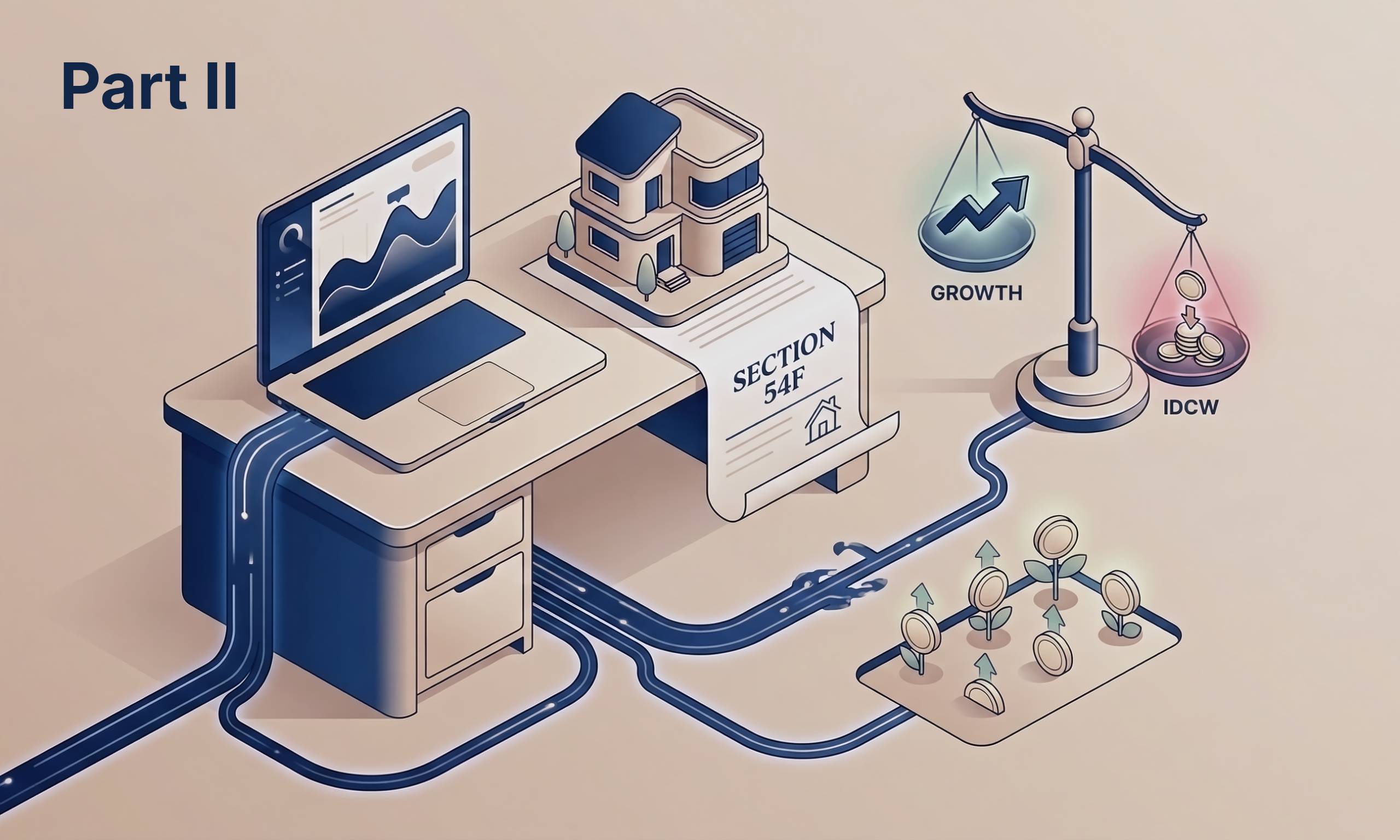
We have covered the basics of taxation on Mutual Fund Incomes in the first part of this series. In this part, we look at some practical applications that will help investors make better decisions.
Turning Tax Understanding into Smarter Choices
Some practical applications of the impact of tax on decision making:
1. Tax Loss and Gain Harvesting:
A temporary dip in portfolio value can be an opportunity. Tax-loss harvesting involves selling investments currently at a loss to offset capital gains from other holdings (or to carry forward the losses for future set-offs). This helps reduce overall taxable capital gains for the year, while allowing you to reinvest in similar/same assets to stay aligned with investment goals.
Tax-gain harvesting is the reverse - it means realising long-term capital gains deliberately, when they fall within the tax-exempt threshold (for instance, up to ₹1.25 lakh in a financial year for equity shares and equity-oriented funds). This resets the purchase cost for future gains, helping manage future tax liability.
However, an investor needs to carefully consider the exit load on mutual funds while harvesting gains/losses. They also need to be careful that including this income does not result in their total income crossing the threshold for surcharge (as discussed above).
2. Growth vs. IDCW:
While the decision of payout option (Growth vs. IDCW) is primarily guided by the investor’s need for regular income (or lack thereof), tax implications also matter in decision-making.
When a distribution is made under IDCW, 2 things happen – (i) A tax liability arises on the distribution, as discussed earlier; (ii) the NAV reduces to the extent of the distribution, implying lower capital gains in the future (when the investor redeems his units). In essence, choosing IDCW prepones the tax liability – from the time of redemption to the time of distribution.
Further, there could be a difference in the tax rate as well. Taking equity-oriented mutual funds as an example, IDCW distributions are taxed at the investor’s slab rate, whereas tax rate at redemption is 20% (short-term) or 12.5% (long term). Apart from the timing of taxation, the investor’s tax bracket can influence which option is more efficient. If the investor’s tax slab is lower than the 20% or 12.5%, IDCW option may result in lower taxes than growth, and vice versa if the investor’s tax slab is higher.
Exemption for Purchase of a House:
Section 54F of the Income Tax Act grants an exemption from tax on long term capital gains, if the proceeds are used to purchase a residential house. Thus, if you sell your mutual funds (classifed as 'long term' based on criteria discussed in the Part 1 of this series) to purchase a house, the gain on sale of mutual funds may be exempt.
The exemption is available only to individuals and HUFs, and involves multiple conditions, which are based on the following:
Number of houses owned by the individual
Timing of purchase or construction of the house
Restriction on additional houses that can be purchased or constructed within the next 1 and 3 years respectively
Pro-rata exemption if the entire sales proceeds are not utilized for purchase/construction of the house
Restriction on sale of the purchased house for 3 years
Restriction on the purchase price of house (Rs. 10 crores), beyond which deduction would be restricted
Please note that we have not listed down all the conditions around the exemption. Further, each of these conditions are very nuanced and have specific rules/guidelines surrounding them -so please consult your tax advisor before decision making.
Thus, if you are allocating a part of your mutual fund investments or SIPs towards your long term goal of purchasing a house, you can avail this exemption and retain most of your underlying returns.
This also ties-back to the concept of tax-gain harvesting - since the funds earmarked for purchase of house would anyway be exempt at the time of redemption, an investor can focus/prioritise gain harvesting on the portion not earmarked for purchase of a house.
Note: Please note that the tax provisions mentioned above are based on the prevailing law as of November 2025 for resident Indian individuals and assumes the investments will be sold after 1 April 2025. Tax provisions are open to interpretation so please consult your tax advisor before any decision making.
FAQs
Q: Are there any drawbacks of capital gains harvesting?
A: The amount of long-term capital gains (that you harvest), even though exempt, is included in the investor's income for the purpose of determining the applicability of surcharge. So, if your other income is close to the threshold for surcharge, tax gain harvesting could result in the overall tax increasing on the investor's other income (due to applicability of surcharge).
Q: I have redeemed 'long term' mutual funds to purchase a residential house.The redemption happened on 30 March 2026, but the house was purchased in the next financial year (in May 2026). Will I still get an exemption on my capital gains under section 54F?
A: As per Section 54F, you can purchase the house within 2 years from the date of redemption of mutual funds. However, if you do not utilize the proceeds before filing your income tax return (the due date for return filing typically falls between 31st July and 30th November), you have to deposit the proceeds in a specified 'Capital Gains Account Scheme' bank account. The amount in that account has to be utilized with 2 years from date of redemption of mutual funds so that the Section 54F exemption stays valid. If it is not utilized, the amount of exemption under section 54F claimed earlier would be subjected to tax.
In Conclusion - Returns may fluctuate, but taxes are certain - and the smartest advisors and investors plan with taxability in mind. If you haven't read the first part (or need a recap), here is the link to the article
For more such insights and a quick, user-friendly platform for distributors, visit Creso - Powering India's Next-Gen Mutual Fund Distributors
Read more from our Blogs

Feb 2, 2026
The Union Budget 2026 - Takeways for Mutual Fund Distributors

Jan 28, 2026
Decoding Debt Mutual Funds (Part III – The Decision Making)
Jan 27, 2026
Decoding Debt Mutual Funds (Part II - Where they stand in the fixed income landscape?)
Jan 26, 2026
Decoding Debt Mutual Funds (Part 1 – The Basics)

Jan 27, 2026
The Retail Tsunami: Dissecting 6 Years of Mutual Fund Growth (2019-2025)

Jan 5, 2026
Changes in Fund Manager - December 2025

Dec 26, 2025
Know Your Mutual Fund House (SBI MF)

Dec 24, 2025
The Long Road to “Mutual Funds Sahi Hai” – A History of Mutual Funds

Jan 16, 2026
Less Is More: A Simple Take on Focused Mutual Funds

Dec 31, 2025
Our Mutual Fund Ranking Framework
Jan 19, 2026
Turn Mutual Funds Into Monthly Income (Part 3 - Key SWP Decisions)
Jan 19, 2026
Turn Mutual Funds Into Monthly Income (Part 2 - Systematic Withdrawal Plans - Reverse SIPs)
Jan 19, 2026
Turn Mutual Funds Into Monthly Income (Part 1 - Stocks Give Dividends, Mutual Funds Have IDCW)
Dec 5, 2025
Changes in Fund Manager - November 2025

Dec 4, 2025
Coffee with Creso: Spark more client conversations, one coffee at a time

Dec 1, 2025
You’ve Checked the Returns - But Have You Checked the Taxes? (Part 3 - Taxation for NRIs)

Jan 19, 2026
Going Global: How Indian Mutual Funds Let You Invest Beyond Borders

Nov 18, 2025
You’ve Checked the Returns, But Have You Checked the Taxes? (Part 1:The Basics)

Oct 14, 2025
How Clients Can Change Email or Mobile on MFCentral (Guide for MFDs)

Sep 3, 2025
GST 2025 for MFDs and Insurance Agents: What Changed, What Didn’t

Aug 28, 2025
How to Open a Minor’s Mutual Fund Account in India

Aug 3, 2025
Change of Broker in Mutual Funds
Partners in prosperity